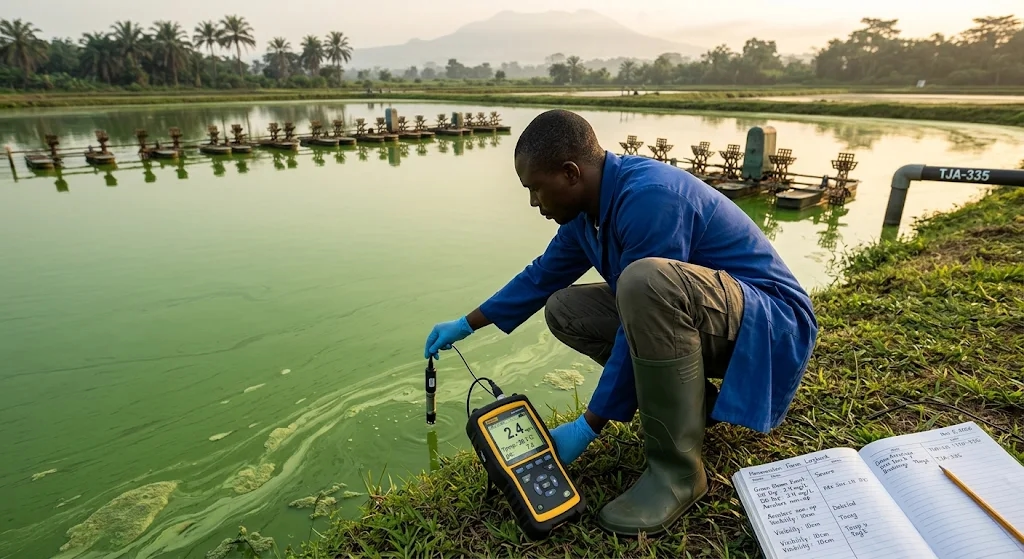
Green water is common in catfish farming and is often caused by the growth of microscopic algae and phytoplankton. These organisms use sunlight and nutrients to grow, giving pond water a green appearance.
In African catfish (Clarias gariepinus) farming, green water is not automatically a sign of poor water quality. Moderate plankton growth can contribute to natural food production, but excessive algal growth can cause large fluctuations in dissolved oxygen and create water-quality problems when algae die and decompose.
The key is to distinguish a manageable plankton population from an excessive or unstable algal bloom.
What Causes Green Water in Catfish Ponds?
1. Excess nutrients in the water
Algae need nutrients to grow. Nitrogen and phosphorus may enter ponds through fish feed, faeces, fertilisers, runoff, and decomposing organic material.
When nutrient availability is high, and other growth conditions are favourable, algae may multiply rapidly.
Common contributing factors include:
- Excessive feeding.
- High fish stocking density.
- Accumulation of organic waste.
- Nutrient-rich incoming water.
- Inappropriate fertiliser use in ponds.
2. Excessive sunlight
Sunlight supports photosynthesis and algal growth. Ponds exposed to strong sunlight may experience increased algal production when sufficient nutrients are available.
Sunlight alone does not necessarily cause excessive green water. Nutrient availability, temperature, and other environmental conditions also influence algal growth.
3. Overfeeding and organic waste
Uneaten feed and fish waste contribute nutrients to the pond. As organic material decomposes, nutrients can become available for algal growth.
Poor feeding management can therefore contribute to both excessive algae and increased oxygen demand.
4. Inadequate water management
When nutrients accumulate faster than they are removed or processed, algae may grow excessively. Poorly managed water exchange, inadequate solids removal, and an overloaded production system can contribute to this problem.
5. Seasonal and environmental changes
Changes in sunlight, rainfall, temperature, and incoming water can alter algal growth. A pond that appears relatively clear may become green when conditions favour rapid multiplication of phytoplankton.
Is Green Water Good or Bad for Catfish?
The effect depends on the type and density of algae, the stability of the pond, and the condition of the fish.
Benefits of moderate plankton growth
In suitable earthen ponds, phytoplankton can support natural food webs and contribute to pond productivity. A moderate plankton population is not necessarily harmful to catfish.
Risks of excessive algal growth
Dense or unstable algal populations can create several problems:
- Oxygen fluctuations: Algae produce oxygen during daylight through photosynthesis but also respire. Dissolved oxygen may fall substantially at night.
- Oxygen depletion after algal die-off: Decomposing algae consume oxygen and may contribute to fish mortality.
- Unstable water quality: Large changes in algal abundance can coincide with changes in pH and dissolved oxygen.
- Potential harmful blooms: Some algae or cyanobacteria can produce harmful substances under particular conditions. Green colour alone cannot identify whether a bloom is toxic.
For these reasons, green water should be assessed using water-quality measurements and fish behaviour rather than colour alone.
Signs That Green Water May Be Causing Problems
Watch for the following warning signs:
| Observation | Possible explanation |
|---|---|
| Water becomes intensely green over a short period | Rapid algal growth |
| Fish gather near the surface early in the morning | Possible low dissolved oxygen |
| Fish show rapid gill movements | Respiratory stress or another water-quality problem |
| Water changes from green to brown or grey | Possible algal decline or changes in suspended material |
| Dead algae accumulate | Decomposition and increased oxygen demand |
| Fish stop feeding normally | Environmental stress, disease, or other problems |
| Sudden fish mortality follows a bloom change | Possible oxygen depletion, harmful bloom effects, or another cause requiring investigation |
These observations are warning signs, not definitive diagnoses.
How to Manage Green Water in Catfish Ponds
1. Measure dissolved oxygen
Dissolved oxygen is particularly important in ponds with dense algal populations. Measure it at different times, especially before sunrise when oxygen may be lowest.
For many catfish grow-out systems, approximately 5 mg/L or higher is a useful general management target, although suitable levels depend on production conditions and fish requirements.
If fish are gasping or showing severe distress, check oxygen immediately and take appropriate corrective action.
2. Reduce excessive nutrient inputs
Review feeding practices and prevent unnecessary organic waste from entering the pond.
- Feed according to fish biomass and feeding response.
- Avoid excessive feed quantities.
- Remove uneaten feed where practical.
- Remove dead fish and decaying material promptly.
- Prevent nutrient-rich runoff from entering the pond.
Reducing excess nutrient inputs can help limit the conditions that support excessive algal growth.
3. Monitor pH and temperature
Dense algal populations can cause pH to change during the day as photosynthesis and respiration alter carbon dioxide concentrations.
Measure pH at appropriate times, particularly when the pond is experiencing an intense bloom or fish show signs of stress. Interpret pH together with ammonia measurements because higher pH can increase the proportion of ammonia in its more toxic un-ionized form.
4. Maintain effective aeration
Aeration can help maintain dissolved oxygen when demand increases. Check that the equipment is operating correctly and can meet the needs of the fish population.
Aeration is particularly important during periods of high biomass, warm weather, and algal instability.
However, aeration does not directly eliminate excess nutrients or solve every problem associated with a dense bloom.
5. Avoid sudden algal die-off
Rapidly killing a dense algal population can cause the dead material to decompose and consume substantial amounts of oxygen.
Do not apply algicides or other chemicals without identifying the problem and establishing a safe management plan. Seek qualified aquaculture advice before using chemical treatments in stocked ponds.
6. Review stocking density and feeding rates
If green water repeatedly develops alongside excessive organic waste or poor oxygen conditions, reassess the pond’s stocking density and feeding programme.
The pond must be able to support the fish biomass while maintaining suitable water quality.
7. Investigate persistent or unusual blooms
If a bloom develops rapidly, produces unusual surface material, or coincides with fish illness or mortality, seek appropriate testing. Microscopic examination or specialist analysis may be necessary to identify the organisms responsible.
Do not assume that every green bloom is harmless phytoplankton or that every green bloom is toxic.
How to Prevent Excessive Green Water
Preventive management focuses on nutrient control and water-quality monitoring.
- Maintain appropriate stocking density.
- Avoid overfeeding.
- Control organic waste accumulation.
- Monitor dissolved oxygen, pH, ammonia, and temperature.
- Maintain reliable aeration.
- Inspect incoming water and runoff pathways.
- Keep records of water colour and fish behaviour.
- Respond early to rapid changes in algal growth.
A simple monitoring record can help reveal whether blooms follow increased feeding, rainfall, fertiliser use, or other changes in pond management.
Frequently Asked Questions
Is green water suitable for African catfish?
Green water can be compatible with catfish production when algal growth is stable and water quality remains suitable. Excessive or unstable blooms can cause oxygen fluctuations and other problems, so water testing is important.
Why do catfish ponds turn green suddenly?
Rapid algal growth may occur when nutrient availability, sunlight, temperature, and other conditions favour phytoplankton multiplication. Changes in feeding, runoff, or fertiliser use may also contribute.
Can green water cause catfish to die?
It can contribute to mortality when dense algal blooms cause severe oxygen depletion, particularly after an algal die-off or during the night. Harmful bloom organisms or unrelated water-quality problems may also be involved. Investigate promptly rather than assuming the colour alone explains the deaths.
Should I change the water when my catfish pond turns green?
Not automatically. First assess the severity of the bloom, dissolved oxygen, and other water-quality parameters. If water exchange is needed, ensure the replacement water is suitable and avoid sudden changes that could stress the fish.
Can I use chemicals to clear green water?
Chemical treatment can create additional risks, particularly if a dense algal population dies rapidly and decomposes. Identify the cause and seek qualified aquaculture advice before using algicides or other chemical products.
Conclusion
Green water in catfish ponds usually results from the growth of algae or phytoplankton supported by available nutrients and favourable environmental conditions. Moderate growth may be acceptable, but excessive or unstable blooms can cause dissolved oxygen fluctuations, pH changes, and increased oxygen demand during decomposition.
For African catfish farmers, effective management means controlling excess nutrients, avoiding overfeeding, maintaining adequate aeration, and monitoring dissolved oxygen and pH. Rapid changes in water colour accompanied by fish distress or mortality require immediate investigation.