Ammonia is an important water-quality risk in catfish farming. It enters pond and tank water through fish waste, uneaten feed and the breakdown of organic matter. When ammonia accumulates, it can stress fish, interfere with normal gill function and contribute to poor growth, disease susceptibility, and mortality.
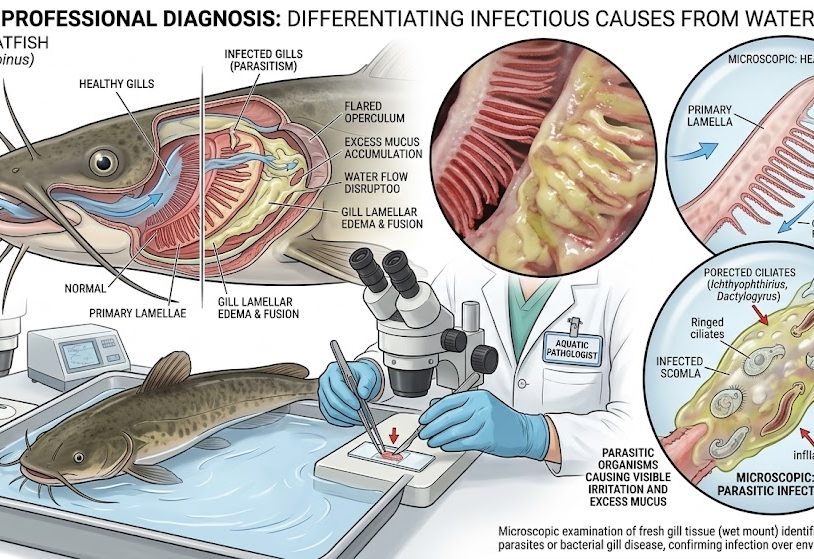
In African catfish (Clarias gariepinus), ammonia-related respiratory distress can resemble bacterial gill disease, fungal infections or parasitic infestations. Testing the water is therefore essential when fish show abnormal breathing or unexplained illness.
What Is Ammonia in Catfish Farming?
Ammonia is a nitrogen-containing waste product released by fish and generated during the decomposition of organic material.
In water, ammonia occurs in two main forms:
- Unionised ammonia (NH₃): Generally the more toxic form to fish.
- Ionised ammonium (NH₄⁺): Generally less toxic than unionised ammonia.
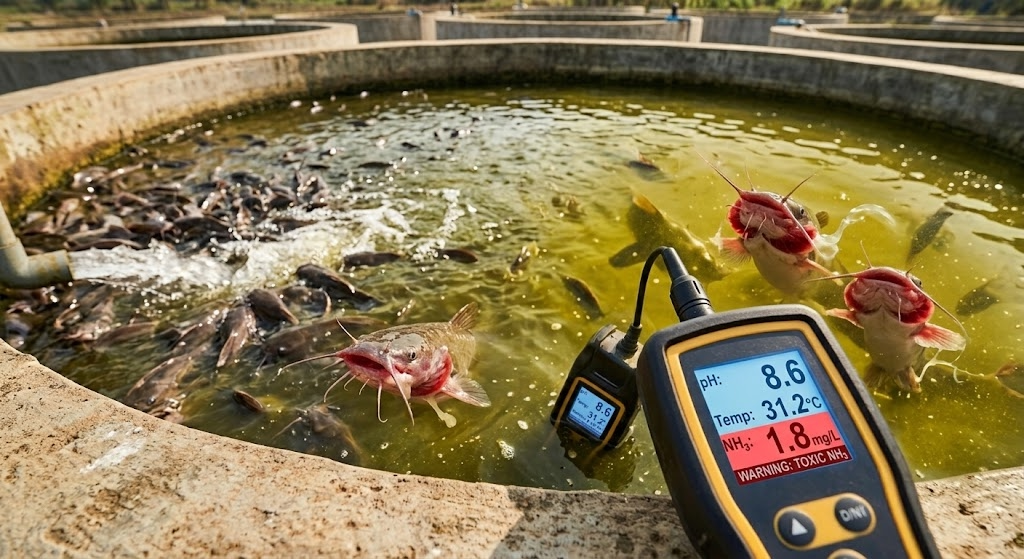
The proportion present as NH₃ increases as pH and temperature rise. This means the same total ammonia concentration can pose different levels of risk under different water conditions.
Farmers should therefore interpret ammonia readings alongside pH and temperature rather than treating a single measurement as the complete picture.
How Ammonia Affects Catfish Gills
1. Gill irritation and impaired function
Elevated ammonia can damage or irritate gill tissue, interfering with normal gas exchange and other gill functions.
2. Respiratory distress
Affected catfish may show rapid gill-cover movement, increased surface breathing or other signs of difficulty breathing. These symptoms are not specific to ammonia exposure.
3. Physiological stress
Ammonia exposure can disrupt normal physiological processes and place additional stress on fish. Prolonged exposure may impair health and performance.
4. Reduced feeding and growth
Fish exposed to unsuitable water conditions may eat less and grow poorly. Reduced feeding is a warning sign, but it does not identify ammonia as the cause by itself.
5. Increased mortality
Severe ammonia toxicity can kill fish. Risk depends on ammonia concentration, the proportion present as NH₃, exposure duration, water conditions, and fish health.
Symptoms of Ammonia Problems in Catfish
Look for a combination of behavioural changes and water-quality evidence.
- Increased gill-cover movement
- Unusual surface breathing
- Reduced appetite or refusal to feed
- Lethargy or abnormal swimming
- Irritated or abnormal-looking gills
- Poor growth or declining condition
- Sudden or increasing mortality in severe cases
African catfish naturally gulp atmospheric air, so surface breathing alone does not prove ammonia toxicity. Gill abnormalities also occur with low oxygen, nitrite toxicity, parasites, and infectious diseases.
What Causes Ammonia to Build Up?
Excessive feeding
Uneaten feed decomposes and contributes to nitrogenous waste. Overfeeding also increases the workload on the pond or tank’s biological waste-processing system.
High stocking density
More fish produce more waste. If water exchange, filtration, and waste processing are inadequate, ammonia can accumulate.
Organic matter accumulation
Faeces, dead organisms and decomposing feed contribute to deteriorating water quality.
Inadequate filtration or water management
In systems that depend on biological filtration, insufficient filtration capacity or disrupted biological processes can reduce the removal of ammonia.
Changes in pH and temperature
Higher pH and higher temperature increase the proportion of total ammonia present as the more toxic unionised form, NH₃. Consequently, ammonia risk can increase even when total ammonia has not changed substantially.
How to Test Ammonia in Catfish Ponds
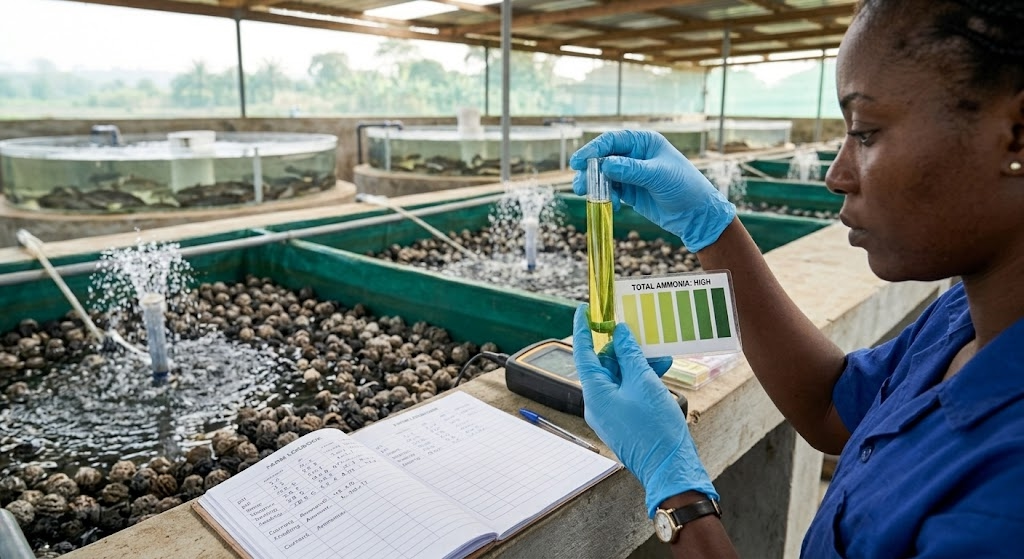
Step 1: Use a suitable water test
Use an appropriate ammonia test kit or meter and follow the manufacturer’s instructions. Identify whether the result represents total ammonia, unionised ammonia or another specified measurement.
Step 2: Measure pH and temperature
Record pH and water temperature alongside the ammonia result. These values are necessary for interpreting the potential toxicity of the reading.
Step 3: Check dissolved oxygen and nitrite
Low dissolved oxygen and elevated nitrite can cause similar symptoms and may occur alongside ammonia problems.
Step 4: Record and repeat measurements
Record results with the date, time, feeding history, and observed fish behaviour. Repeat testing when readings are abnormal or fish continue to show distress.
Step 5: Seek assistance when results are concerning
If ammonia is elevated or fish are dying, obtain advice from a qualified aquaculture professional on corrective action appropriate to the production system.
What to Do When Ammonia Is High
When ammonia toxicity is suspected, prioritise fish welfare and safe correction of the water-quality problem.
- Confirm the reading. Test ammonia and measure pH, temperature and dissolved oxygen.
- Reduce feeding temporarily if appropriate. Avoid adding feed that distressed fish will not consume. Resume feeding according to fish condition and water quality.
- Support oxygen availability. Provide suitable aeration if dissolved oxygen is low or respiratory distress is occurring.
- Review waste accumulation. Remove excess organic waste using methods appropriate to the system.
- Assess water exchange or treatment options. Use only procedures suitable for the pond or tank, and avoid abrupt changes that may create additional stress.
- Check filtration performance. In systems with biological filtration, investigate whether the filter is operating correctly.
- Monitor recovery. Retest water quality and observe feeding, swimming and mortality.
Do not make large, uncontrolled changes to water chemistry or add chemicals without understanding the water conditions and the product’s suitability.
How to Prevent Ammonia Toxicity in Catfish
Feed according to fish requirements
Use suitable feed and adjust feeding to fish size, biomass, appetite and production conditions. Remove accumulating uneaten feed where practical.
Control stocking density
Match the number and biomass of fish to the system’s water exchange, filtration, oxygen supply and waste-processing capacity.
Maintain effective waste management
Prevent excessive accumulation of organic matter and keep the pond or tank clean using appropriate procedures.
Monitor water quality routinely
Test ammonia, pH, temperature, nitrite and dissolved oxygen. Keeping records makes it easier to identify recurring problems and track the results of corrective action.
Maintain biological filtration
For systems using biological filters, follow appropriate maintenance practices and avoid actions that unnecessarily disrupt the biological processes responsible for converting ammonia.
Act early when fish show distress
Do not wait for mortality before investigating. Reduced appetite, abnormal breathing and deteriorating water-quality readings warrant prompt assessment.
Ammonia Toxicity Versus Gill Disease
| Finding | What it may indicate |
|---|---|
| Elevated ammonia test result | Ammonia accumulation requiring assessment |
| High pH and temperature alongside ammonia | Potentially greater unionised-ammonia risk |
| Rapid gill movement | Respiratory distress from several possible causes |
| Visible gill damage | Possible ammonia injury, infection, parasites or another irritant |
| Poor feeding and slow growth | Water-quality stress, disease or nutritional problems |
| Symptoms continue after water quality improves | Further investigation may be needed |
These observations help guide an investigation but do not replace diagnosis.
Frequently Asked Questions
Can ammonia damage catfish gills?
Yes. Elevated ammonia can injure or irritate gill tissue and interfere with normal gill function. The severity depends on the level and duration of exposure and the surrounding water conditions.
Why is ammonia more dangerous at high pH?
Higher pH shifts the balance between ionised ammonium and unionised ammonia toward NH₃, the more toxic form. Temperature also influences this balance.
Can ammonia make catfish stop eating?
Yes. Ammonia exposure and the associated water-quality stress can reduce appetite. However, disease, poor feed quality, and other environmental problems can cause the same behaviour.
Can ammonia toxicity be mistaken for bacterial gill disease?
Yes. Both can involve respiratory distress and abnormal gill appearance. Water testing and appropriate fish examination help distinguish environmental injury from infection.
Should I use a chemical to remove ammonia?
Only after assessing the water conditions and confirming that the product and procedure are suitable for the production system. Unnecessary or incorrectly applied chemicals can harm fish or disrupt water chemistry.