Testing catfish pond water is essential for maintaining fish health, preventing water quality problems and supporting consistent growth. Poor water conditions can cause reduced feeding, respiratory distress, slow growth and sudden mortality, even when the fish initially appear healthy.
For farmers raising African catfish (Clarias gariepinus), regular water testing helps identify problems involving dissolved oxygen, ammonia, nitrite, pH, and temperature before they become severe.
Why Water Testing Is Important in Catfish Farming
Water quality changes continuously as fish feed, produce waste, consume oxygen, and interact with microorganisms in the pond.
Regular testing helps farmers:
- Detect low dissolved oxygen before it causes severe stress.
- Identify ammonia and nitrite accumulation.
- Monitor pH fluctuations.
- Check whether water temperature remains suitable.
- Investigate reduced feeding and unusual swimming behaviour.
- Evaluate the effects of feeding, stocking density, and water exchange.
- Make informed water management decisions.
Visual observation alone is not enough. Water can appear clean while containing harmful concentrations of dissolved pollutants.
The Main Water Quality Parameters to Test
1. Dissolved Oxygen
Dissolved oxygen (DO) is the oxygen available in water for fish and other aquatic organisms.
Low dissolved oxygen can cause catfish to gasp at the surface, gather near water inflows, reduce feeding, or become weak.
A commonly used management target for intensive aquaculture is around 5 mg/L or higher, although requirements vary with the farming system and conditions. Lower concentrations can increase stress, particularly in heavily stocked systems.
How to test: Use a calibrated dissolved oxygen meter or a suitable water test kit. Check more frequently during hot weather, periods of heavy feeding, and suspected oxygen depletion.
2. Ammonia
Ammonia enters pond water through fish waste, uneaten feed and decomposing organic matter.
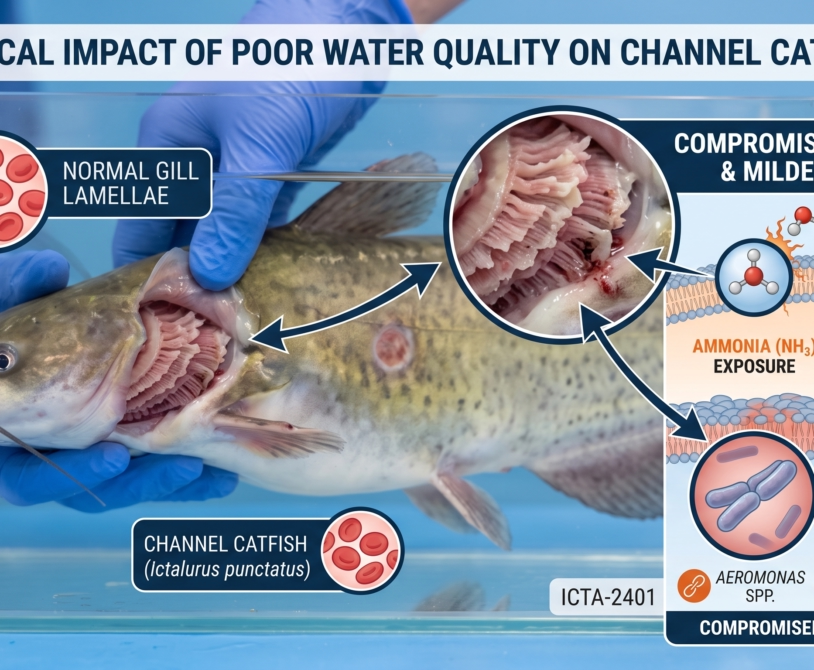
High ammonia concentrations can damage gills, interfere with normal physiological functions and cause mortality.
Ammonia toxicity depends on total ammonia concentration, pH and temperature. The un-ionized form, NH₃, is particularly toxic.
How to test: Use an appropriate ammonia test kit or meter. Record the result together with pH and temperature so that the reading can be interpreted correctly.
3. Nitrite
Nitrite forms during the biological processing of nitrogenous waste. When it accumulates, it can interfere with the blood’s ability to transport oxygen.
Affected fish may show respiratory distress, weakness, poor feeding, and abnormal swimming.
How to test: Use a suitable nitrite test kit and confirm whether the result is reported as nitrite or nitrite-nitrogen, because the units differ.
4. pH
pH measures how acidic or alkaline the water is.
A practical management range often used for freshwater aquaculture is approximately 6.5–8.5, but suitability depends on the species, production system, and other water quality conditions.
Sudden pH changes can stress fish, while high pH can increase ammonia toxicity.
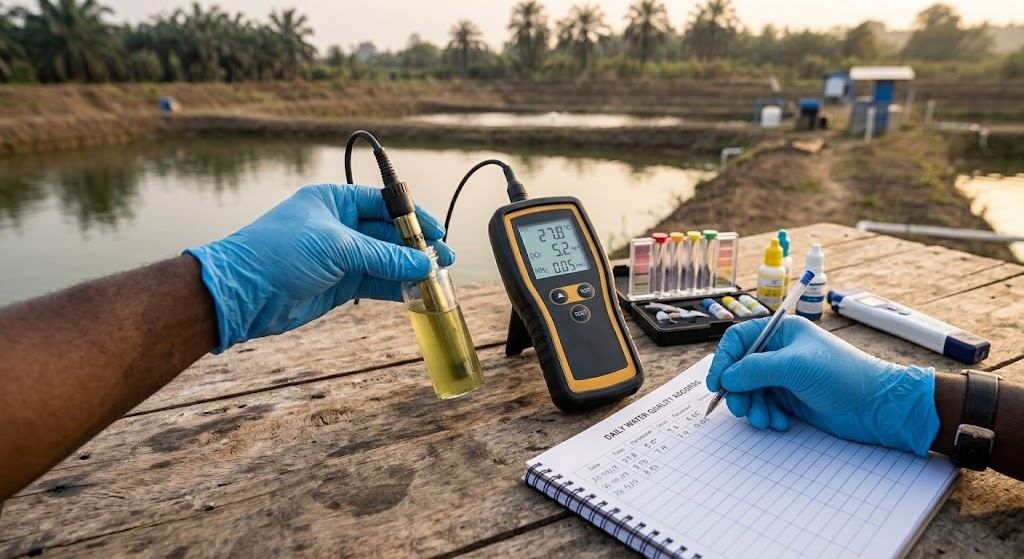
How to test: Use a calibrated digital pH meter or a suitable pH test kit. Record the time because pond pH may change between morning and afternoon.
5. Water Temperature
Temperature affects catfish metabolism, feeding, growth, dissolved oxygen availability and ammonia toxicity.
A practical grow-out management range for African catfish is approximately 26–30°C, although the suitable range depends on fish size and production conditions.
How to test: Measure the water directly using a reliable thermometer. Do not use air temperature as a substitute.
6. Alkalinity
Alkalinity describes the water’s capacity to resist changes in pH.
Low alkalinity can make pH less stable, while adequate buffering capacity can help reduce large fluctuations.
How to test: Use a suitable alkalinity test kit, particularly when pH changes significantly or repeatedly.
Equipment Needed for Catfish Pond Water Testing

Dissolved oxygen meter
Measures oxygen concentration in the pond water, helping identify oxygen depletion.

Water quality test kit
Can measure parameters such as ammonia, nitrite and pH, depending on the kit.

Digital pH meter
Provides pH readings when properly calibrated and maintained.

Water thermometer
Measures actual pond or tank temperature.
Choose equipment suitable for aquaculture and follow the manufacturer’s instructions. Keep test reagents within their expiry dates and maintain meters according to their calibration requirements.
Step-by-Step Guide to Testing Catfish Pond Water
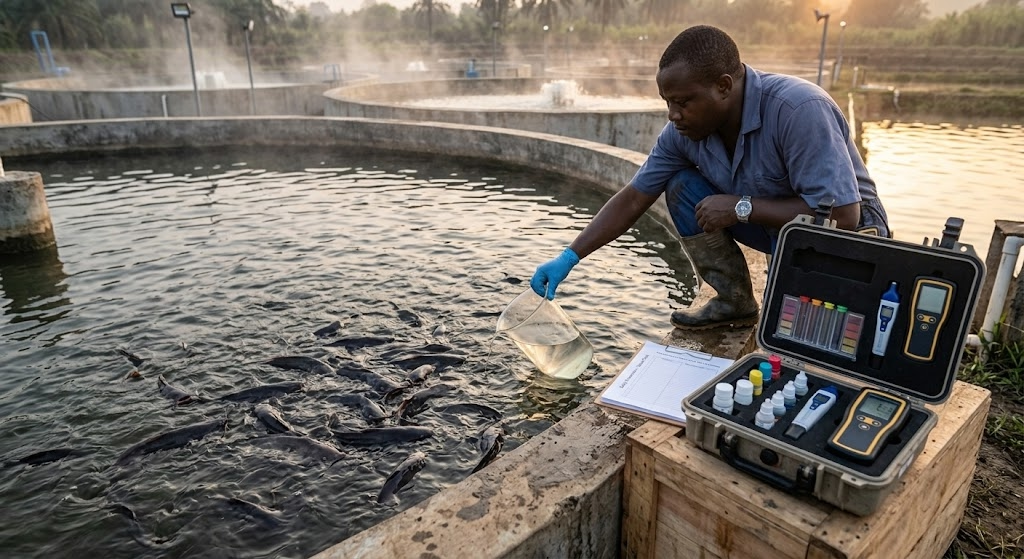
Step 1: Collect a representative sample
Collect water from a representative part of the pond rather than relying on a single surface sample. Avoid sampling directly beside a feed pile, inflow or unusual waste accumulation unless you specifically want to investigate that location.
For large or uneven ponds, test more than one location when practical.
Step 2: Measure temperature
Measure the water temperature and record the time. This provides important context for interpreting other readings.
Step 3: Measure dissolved oxygen
Check dissolved oxygen, especially if fish are gasping, feeding poorly or gathering near water inflows.
In ponds where oxygen depletion is a concern, measurements near dawn can be particularly useful because oxygen may decline overnight.
Step 4: Test pH
Use a calibrated meter or suitable test kit. Record the result and compare it with previous measurements to identify changes.
Step 5: Test ammonia and nitrite
Follow the instructions for the specific test kit. Observe the required sample volume, reagent quantities and waiting time.
Record the result and its units. If ammonia is elevated, interpret it alongside pH and temperature.
Step 6: Test alkalinity when necessary
If pH fluctuates significantly, alkalinity testing can help determine whether the water has sufficient buffering capacity.
Step 7: Record and interpret the results
Compare readings with suitable management targets for the particular system. Consider fish behaviour, recent feeding, stocking density, weather and other water quality parameters before deciding on corrective action.
How Often Should Catfish Farmers Test Pond Water?
Testing frequency depends on stocking density, feeding rate, pond conditions and the stability of the water.
| Parameter | Suggested monitoring approach |
|---|---|
| Dissolved oxygen | Daily in intensive systems; more often during suspected oxygen problems |
| Temperature | Daily, preferably at consistent times |
| pH | Regularly, with additional checks when fluctuations are suspected |
| Ammonia | Regularly and whenever fish show signs of stress or waste accumulates |
| Nitrite | Regularly, especially in intensive or newly established systems |
| Alkalinity | Periodically and when pH stability becomes a concern |
These are general monitoring recommendations, not fixed requirements for every farm. Intensive systems may require more frequent testing than lightly stocked ponds.
Common Signs That Your Catfish Pond Water Needs Testing
Test the water promptly when you notice:
- Catfish gasping at the water surface.
- Fish swimming abnormally or losing coordination.
- Sudden reductions in feeding.
- Fish gathering around water inlets.
- Unexpected mortality.
- Unusual foam, cloudiness or changes in water colour.
- Strong or unpleasant odours.
- Rapid changes in weather or water conditions.
None of these signs identifies a single cause by itself. Test the water before deciding whether the problem involves oxygen, ammonia, nitrite, pH or disease.
Common Water Testing Mistakes
Using expired test reagents
Expired or improperly stored reagents may produce unreliable results. Check expiry dates and storage instructions.
Testing only when fish look sick
Some water quality problems develop before obvious symptoms appear. Routine testing helps identify changes earlier.
Ignoring the units
Ammonia and nitrite tests may report results using different chemical conventions. Confirm the units before comparing results with management targets.
Relying on one measurement
Water quality can vary by location and time of day. Repeat questionable readings and collect additional samples where necessary.
Making corrections without confirming the problem
Adding chemicals or changing water conditions based on guesswork can worsen the situation. Verify the reading and choose corrective measures appropriate to the farming system.
Catfish Pond Water Testing Record Template
Use the following table to record your results.
| Date and time | Temperature (°C) | DO (mg/L) | pH | Ammonia | Nitrite | Observations or action |
|---|---|---|---|---|---|---|
Record the units for ammonia and nitrite, as well as the measurement method. Add alkalinity or other parameters when relevant.
Frequently Asked Questions
Can catfish pond water look clean but still be unsafe?
Yes. Dissolved ammonia, nitrite and low oxygen may not be visible. Testing is necessary to assess these conditions.
What is the most important water parameter to test first?
Dissolved oxygen is an immediate priority when fish are gasping or showing respiratory distress. However, ammonia, nitrite, pH and temperature should also be checked to identify the underlying problem.
Can I use aquarium test kits for catfish ponds?
Some aquarium kits can be suitable for aquaculture water testing if their measurement range, accuracy and units are appropriate. Follow the manufacturer’s instructions and choose equipment designed for the parameters you need to monitor.
Why should I test water early in the morning?
In ponds with substantial algae or plant activity, dissolved oxygen can fall overnight because respiration continues while photosynthesis stops. Early-morning testing can help reveal oxygen depletion that may not be obvious later in the day.
Does every catfish farmer need an expensive digital meter?
Not necessarily. Suitable test kits can provide useful measurements for several parameters. However, reliable dissolved oxygen measurement is especially valuable in intensive systems where oxygen problems can develop quickly.
Conclusion
Regular water testing is a fundamental part of successful catfish farming. Monitoring dissolved oxygen, ammonia, nitrite, pH, temperature and alkalinity helps farmers identify developing problems and make informed management decisions.
Combine accurate measurements with feeding control, waste removal, adequate aeration and effective filtration. When fish show signs of distress, test promptly and investigate the underlying cause instead of relying on appearance alone.