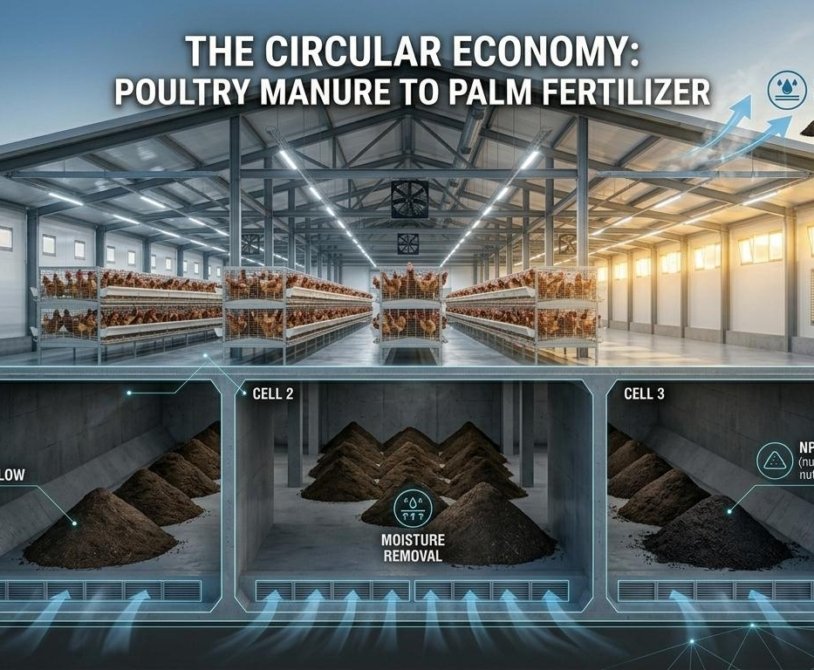

The layer farm produces two marketable outputs: eggs and manure. Most farmers are aware of the first. Fewer systematically exploit the second.
A 1,000-bird commercial layer operation produces approximately 15–25 tonnes of litter material over a 72-week production cycle — a blend of chicken droppings, wood shavings, feathers, spilled feed, and water that, when raw, is a waste management liability. When correctly composted, that same material becomes a premium organic fertilizer worth XAF 10,000–25,000 (USD 17–42) per tonne in the peri-urban agricultural markets of Cameroon, Nigeria, and Ghana — where vegetable farmers, maize producers, and horticultural operations pay premium prices for organic inputs that reduce their dependency on increasingly expensive imported synthetic fertilizers.
The transformation from waste to premium product requires one thing: the composting process managed correctly. Raw poultry litter applied directly to crops burns plant roots from ammonia and urea toxicity, spreads Salmonella and E. coli from fecal contamination, and attracts flies that create a neighborhood nuisance and regulatory risk. Composted poultry litter does none of these things — the heat generated by the composting process kills human pathogens, stabilizes nitrogen into plant-accessible forms, and produces a material that handles, smells, and performs like commercial organic fertilizer.
This article covers the complete composting process for layer farm litter: the chemistry that makes composting work, the practical management protocol, the quality parameters of finished compost, and the market positioning that turns a secondary revenue stream into a meaningful contribution to the farm’s financial performance.
Why Poultry Manure Is the Highest-Value Livestock Manure
Before covering the composting process, establish why poultry litter commands the prices it does in West African organic farming markets.
Nutrient Content Comparison
| Manure Type | Nitrogen (N) % | Phosphorus (P₂O₅) % | Potassium (K₂O) % | Relative Fertilizer Value |
|---|---|---|---|---|
| Layer hen litter (raw) | 2.5–3.5% | 2.0–2.8% | 1.5–2.2% | Very high |
| Layer hen compost (finished) | 2.0–2.8% | 1.8–2.5% | 1.2–1.8% | High |
| Cattle manure (fresh) | 0.5–0.8% | 0.3–0.5% | 0.5–0.8% | Low |
| Cattle manure (composted) | 0.4–0.6% | 0.3–0.5% | 0.4–0.7% | Low–Moderate |
| Pig manure (fresh) | 0.8–1.5% | 0.6–1.2% | 0.4–0.8% | Moderate |
| Pig manure (composted) | 0.6–1.2% | 0.5–1.0% | 0.4–0.7% | Moderate |
Layer hen litter contains 3–5× more nitrogen per tonne than cattle manure and 2–4× more than composted pig manure. On a nutrient-equivalent basis, one tonne of composted layer litter delivers the same nitrogen as 5–7 tonnes of composted cattle manure. This nutrient density is why vegetable farmers and maize producers pay a premium for poultry-sourced compost — the logistics of transporting 1 tonne to deliver the equivalent fertility of 6 tonnes is a significant practical advantage.
The Organic Matter Bonus
Beyond the NPK content, composted poultry litter contributes organic matter to the soil — improving water retention in sandy tropical soils, increasing cation exchange capacity (the soil’s ability to hold and release plant nutrients), and feeding the soil microbial community that drives nutrient cycling. These benefits persist in the soil for 2–4 years after a single application, unlike synthetic fertilizers, whose effect is largely exhausted within a single growing season.
This durability is the argument that premium-paying organic farmers make to justify the higher price of composted poultry litter over synthetic NPK — and the argument that positions layer farm compost correctly in the market.
The Chemistry of Composting: What Is Actually Happening in the Pile
Understanding the chemical processes in composting is not academic — it is the practical knowledge that determines whether a compost pile reaches the temperature required to kill pathogens, whether nitrogen is lost to the atmosphere as ammonia, and whether the finished product is stable enough to apply without burning crops.
The Carbon-to-Nitrogen Ratio (C:N)
Composting is performed by microorganisms — primarily bacteria and fungi — that use organic matter as both a carbon energy source and a nitrogen source for cell growth. The ratio of carbon to nitrogen in the composting material determines how actively these organisms work and how efficiently nitrogen is retained.
The target C:N ratio for active composting: 25:1 to 30:1
- Below 20:1 (nitrogen-rich, carbon-poor): Microbial activity is limited by available carbon. Excess nitrogen is released as ammonia gas — the sharp smell of a poorly managed manure pile. The pile fails to generate adequate heat. The finished product may have elevated ammonia that burns plant roots.
- Above 40:1 (carbon-rich, nitrogen-poor): Microbial activity is limited by available nitrogen. The pile takes much longer to decompose and may not generate adequate thermophilic temperatures to kill pathogens.
Layer litter C:N ratio depends on the bedding material:
| Material | C:N Ratio | Adjustment Needed |
|---|---|---|
| Chicken droppings alone | 5–7:1 | Too nitrogen-rich; must add carbon |
| Layer litter (droppings + wood shavings, 1:1 ratio) | 15–20:1 | Slightly low; may benefit from additional carbon |
| Layer litter (droppings + wood shavings, 1:2 ratio) | 22–30:1 | Near optimal |
| Layer litter + dry maize stover addition | 25–35:1 | Optimal range |
In practice: Most layer farm litter from a cage or floor system at the end of a 72-week cycle already contains significant wood shaving content (from litter top-dressing throughout the cycle) and is in the 15–22:1 C:N range. Adding dry maize stover, rice straw, dried grass clippings, or dry wood chips at a rate of 20–30% by volume of the litter corrects the ratio to the optimal 25–30:1 range without requiring precise measurement.
The Thermophilic Phase: The Pathogen Kill
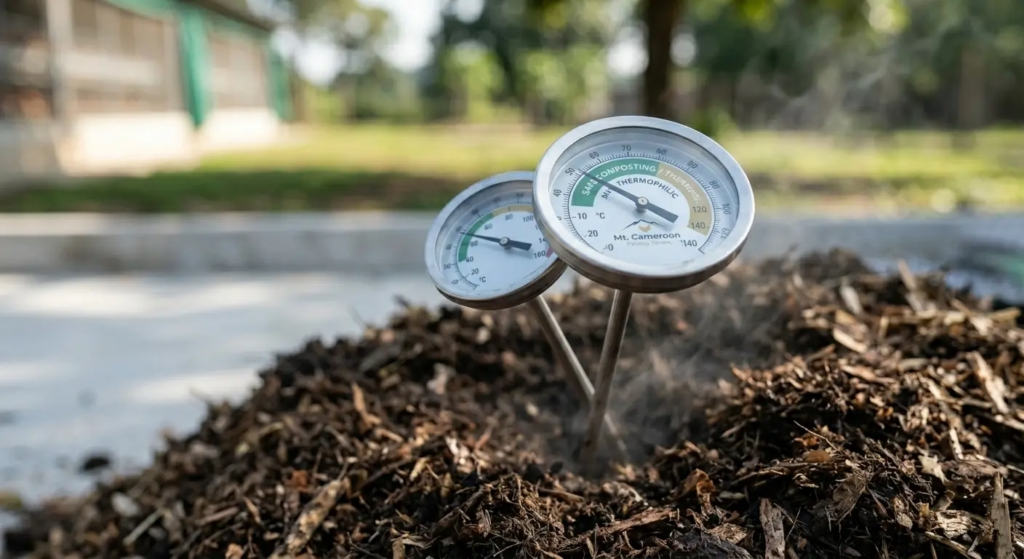
The most important event in composting is the thermophilic (high-temperature) phase — when microbial metabolic activity generates enough heat to raise the pile’s internal temperature above 55°C for a sustained period.
Why temperature matters:
| Temperature | Duration | Pathogens Killed |
|---|---|---|
| 55°C | 3 days | Most fecal bacteria, including Salmonella, E. coli, and Campylobacter |
| 60°C | 2 days | Virtually all fecal pathogens; most helminth eggs (Ascaridia oocysts) |
| 65°C+ | 1 day | Essentially complete pathogen elimination; weed seed sterilization |
| Below 50°C | Any duration | Pathogens survive; compost is not food-safe for crop application |
A compost pile that never exceeds 50°C is not safe compost — it is decomposed manure that still carries its original pathogen load. The thermophilic temperature must be reached and sustained in every part of the pile, not just the center, which is why turning (physically rotating the pile material to move outer material to the hot center) is the most critical management intervention in the composting process.
The thermophilic phase in correctly managed layer litter compost:
- Begins within 48–72 hours of pile construction if the C : N ratio and moisture are correct
- Reaches 55–65°C in the pile interior within 3–5 days
- Sustained for 7–14 days with adequate moisture and oxygen
- Maintained through at least 2 full turning events to ensure all material passes through the hot zone
The Practical Composting Protocol
Step 1 — Site Selection
Choose the composting site based on:
- Distance from the layer house: Minimum 10 meters from the house perimeter to prevent odor and fly pressure from the composting pile affecting the production flock
- Distance from water bodies: Minimum 30 meters from any stream, pond, or borehole to prevent nutrient leaching into water sources
- Drainage: Position on slightly elevated ground or on a concrete pad to prevent standing water from saturating the base of the pile
- Access: Accessible to a wheelbarrow or small tractor for loading, turning, and removal
- Shade: Partial shade reduces moisture evaporation from the pile surface — maintaining adequate moisture is easier in a shaded site
Step 2 — Pile Construction
Target pile dimensions:
- Width: 1.5–2.0 meters (allows adequate oxygen penetration to the center)
- Height: 1.0–1.5 meters (retains heat without creating anaerobic conditions at the center)
- Length: Any practical length — extend the pile rather than increasing height or width
Construction sequence (layering method):
Layer 1 — Base: 15–20 cm of dry carbon material (wood chips, straw, or dry maize stover). This base layer provides oxygen pathways at the bottom and prevents the pile from becoming waterlogged at the base.
Layer 2 — Litter: 20–25 cm of layer farm litter (droppings + existing wood shavings from the house)
Layer 3 — Carbon amendment: 5–8 cm of additional dry carbon material (if the litter’s C:N ratio is below 20:1)
Repeat Layers 2 and 3 until the pile reaches the target height.
Moisture at construction: The pile should have a moisture content of 50–60% — the “squeezed fist” test. Grab a handful of pile material and squeeze firmly in the fist. At correct moisture: 1–2 drops of water emerge, and the material holds its shape briefly before crumbling. Too dry: no water emerges, material crumbles immediately. Too wet: water streams from the hand.
If the litter is too dry (below 40% moisture, which can occur in the harmattan season): add water by hosing the pile lightly during construction. If the litter is too wet (above 70% moisture, which can occur during rainy season cleanouts), mix additional dry carbon material to absorb excess moisture before stacking.
Step 3 — Active Phase Management (Weeks 1–4)
Temperature monitoring: Insert a long-stem compost thermometer or metal rod (leave for 10 minutes, then remove and check the temperature by touch) into the center of the pile every 2–3 days. Record the reading.
Temperature response protocol:
| Temperature Reading | Action |
|---|---|
| Below 45°C at day 5 | Pile is not activating — check moisture and C:N; add nitrogen source (fresh grass clippings or small amount of urea at 0.5 kg/tonne) if pile is too dry; add water if below optimal moisture |
| 55–65°C | Optimal — no action required |
| Above 70°C | Pile overheating — oxygen may be insufficient; turn the pile to restore airflow and reduce temperature |
Turning protocol:
Turn the pile for the first time when the internal temperature begins to decline from its peak (typically 10–14 days after construction). Turning does three things simultaneously:
- Moves cooler outer material to the hot interior — exposing it to the pathogen-killing temperatures it has not yet experienced
- Restores oxygen to the interior — preventing anaerobic conditions that produce sulfur and methane odors
- Releases CO₂ and excess heat — allowing the microbial community to re-activate with fresh oxygen
Turn a second time 10–14 days after the first turning. A total of 2–3 turnings is standard for a 6–8 week composting cycle.
After each turning: Check moisture. If the pile feels dry on the outer layers, apply water lightly with a hose during the turning process. Maintain the 50–60% moisture range throughout the active phase.
Step 4 — Maturation Phase (Weeks 5–8)
After the second turning, the pile enters the maturation phase — temperatures drop to 35–45°C as easily decomposable material is exhausted and the microbial community shifts toward fungal-dominated decomposition. The pile volume decreases by 40–60% from the original construction volume.
The maturation phase is where the nitrogen is stabilized — converted from soluble ammonium forms (which can burn plant roots) to more stable organic nitrogen forms that release slowly in the soil. Do not apply immature compost that is still hot (above 50°C) or that still smells strongly of ammonia — these are signs that the maturation phase is incomplete.
Testing Compost Maturity: Field Methods
A compost batch is ready to apply when all of the following field tests are satisfied:
Temperature test: Internal pile temperature has stabilized below 40°C and does not rise significantly in the 48 hours after turning. A pile that reheats to 55°C after turning is still in the active phase.
Odor test: Finished compost smells earthy and neutral — similar to fresh forest soil. No ammonia odor (nitrogen instability). No sulfur or rotten-egg odor (anaerobic conditions). If either odor is present, continue composting with additional turnings.
Appearance test: Material is dark brown to black, homogeneous, and crumbly — original litter structure (recognizable shavings, droppings, feathers) is no longer visible as distinct components. Some coarse material (partially decomposed wood chips) is acceptable.
Germination test (definitive): Place 50g of compost in a small container. Plant 10 radish or maize seeds at a depth of 1 cm. Water lightly and place in a warm area for 7 days. Count germinated seeds. If the germination rate exceeds 70% of the control (seeds planted in standard potting soil), the compost is mature and safe for crop application. If germination is below 70% of the control, phytotoxic compounds remain — continue maturation for 2 additional weeks and repeat.
Compost Quality Parameters: What Buyers and Farmers Need to Know
Commercial buyers of composted layer litter — vegetable farmers, maize producers, horticultural operations — make purchasing decisions based on nutrient content and pathogen safety. Having your compost laboratory-tested and providing a certificate of analysis is the single most effective way to command premium pricing in formal markets.
Minimum parameters for commercial compost certification:
| Parameter | Target Range | Method |
|---|---|---|
| Total nitrogen (N) | 2.0–2.8% dry weight | Laboratory analysis |
| Total phosphorus (P₂O₅) | 1.8–2.5% dry weight | Laboratory analysis |
| Total potassium (K₂O) | 1.2–1.8% dry weight | Laboratory analysis |
| Organic matter content | 40–65% dry weight | Loss on ignition |
| Moisture content | 25–40% | Gravimetric drying |
| pH | 6.5–8.0 | pH meter |
| Salmonella | Absent (0 per 25g) | Microbiological culture |
| E. coli | Below 1,000 CFU/g | Microbiological culture |
| Germination rate | Above 70% of control | Seed germination test |
In Cameroon and Nigeria, agricultural laboratory services for compost analysis are available through IRAD (Institut de Recherche Agricole pour le Développement) in Cameroon and the IAR (Institute for Agricultural Research) in Nigeria. Analysis cost: XAF 50,000–150,000 (USD 83–250) for a standard NPK + pathogen panel. A certificate of analysis justifies a 20–40% price premium over uncertified compost in formal agricultural supply channels.
Application Rates for Key West African Crops
Providing crop-specific application rate guidance to buyers differentiates composted layer litter from generic “organic fertilizer” and positions the farm as an agricultural knowledge partner rather than simply a waste disposal service.
Vegetable Crops (Tomatoes, Peppers, Leafy Vegetables)
Application rate: 8–15 tonnes per hectare, incorporated 15–20 cm into the soil 2–3 weeks before transplanting. Allow the 2–3 week pre-plant incorporation period for the residual biological activity in the compost to stabilize before root contact.
Equivalent synthetic fertilizer displaced: 8 tonnes of 2.5% N compost delivers 200 kg of organic nitrogen — equivalent to approximately 430 kg of urea (46% N) in total nitrogen content, though the slow-release nature of organic nitrogen means application effectiveness is 60–70% of equivalent synthetic rate in the first season, improving in subsequent seasons as soil organic matter builds.
Effect on yield: Field trials with composted poultry litter on tomato in the Nigerian and Cameroonian research literature consistently show 15–30% yield improvement over un-amended control plots, and comparable yield to synthetic NPK at equivalent nutrient rates.
Maize
Application rate: 5–10 tonnes per hectare, broadcast and incorporated before planting. Higher rates are warranted on degraded soils with low organic matter content (common in peri-urban areas where land has been continuously cropped without organic matter return).
Synergy with synthetic fertilizer: In smallholder systems where synthetic fertilizer is also used, applying composted layer litter at 3–5 tonnes/ha and synthetic NPK at 50–60% of the standard recommendation consistently outperforms either input alone — the organic matter improves nutrient use efficiency of the synthetic fertilizer.
Plantain and Banana
Application rate: 15–25 kg per plant per year for mature stands; 10–15 kg per planting hole at establishment. Apply at the start of the rainy season to coincide with active root growth.
Oil Palm
Application rate: 30–50 kg per stand per year, applied in a 1-meter ring around the base of the palm. Poultry litter compost is particularly effective for oil palm because the high potassium content supports fruit development and oil synthesis.
The Revenue Calculation: What Compost Adds to the Farm’s Income
Raw Material From One 72-Week Cycle (1,000 Birds)
- Litter volume removed at cleanout: 15–25 tonnes (variable with litter depth management and number of top-dressings during the cycle)
- Volume loss during composting (40–60% reduction): 6–15 tonnes of finished compost
- Finished compost weight: 9–12 tonnes per cycle (conservative estimate after volume and weight reduction)
Revenue at Current West African Market Prices (2026)
| Market Channel | Price per Tonne | Revenue (9–12 tonnes) | USD Equivalent |
|---|---|---|---|
| Uncertified bulk sale to local farmers | XAF 10,000–15,000 | XAF 90,000–180,000 | USD 150–300 |
| Certified compost to vegetable farmers | XAF 18,000–25,000 | XAF 162,000–300,000 | USD 270–500 |
| Bagged retail compost (25 kg bags) | XAF 40,000–60,000/tonne | XAF 360,000–720,000 | USD 600–1,200 |
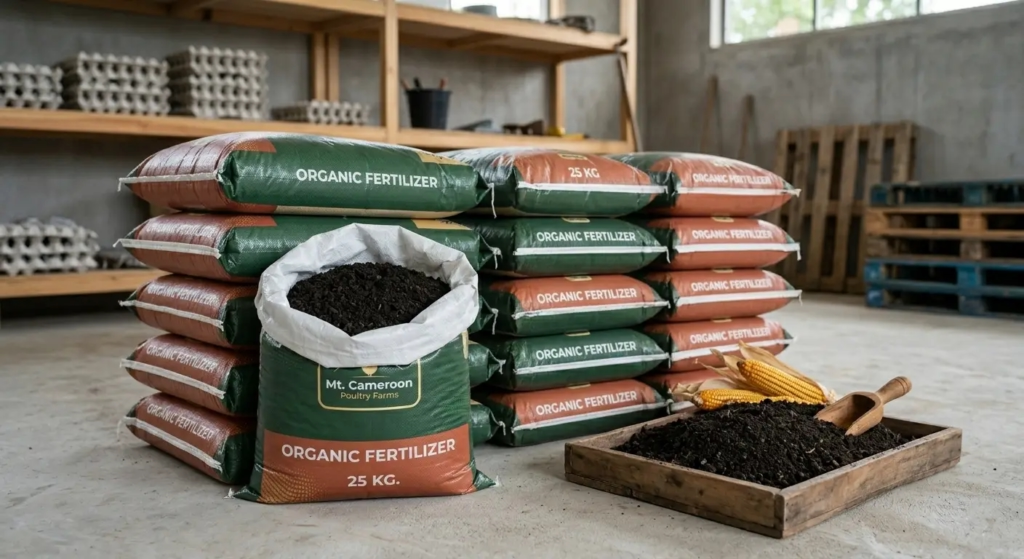
The bagged retail channel — processing finished compost into labeled 25 kg bags sold at agricultural input shops or directly to smallholder vegetable farmers — delivers the highest revenue per tonne at XAF 40,000–60,000 (USD 67–100) per tonne. At 10 tonnes of finished compost, bagged retail generates XAF 400,000–600,000 (USD 667–1,000) per production cycle.
The additional costs of bagging — 400 bags at XAF 200–350 each = XAF 80,000–140,000 (USD 133–233) — are recovered in the price premium above bulk sale within the first 2–3 tonnes sold at retail pricing.
The Total Cycle Revenue Contribution
At a 1,000-bird farm over a 72-week cycle:
| Revenue Source | Amount (XAF) | Amount (USD) |
|---|---|---|
| Certified bulk compost (10 tonnes at XAF 20,000/tonne) | 200,000 | 333 |
| Additional premium from bagged retail | 200,000–400,000 | 333–667 |
| Total compost revenue per cycle | 400,000–600,000 | 667–1,000 |
This XAF 400,000–600,000 (USD 667–1,000) per cycle from composted litter represents approximately 2% of total cycle revenue — a modest contribution in percentage terms, but one that is generated from material that is otherwise a disposal cost. The farm that pays XAF 30,000–80,000 (USD 50–133) to have litter removed is converting a revenue opportunity into a cost.
Biogas: The Alternative to Composting
Where electricity costs are high and capital is available, layer farm manure can be processed through an anaerobic biogas digester rather than composted aerobically. Biogas production converts manure to methane gas (used for cooking or electricity generation) and produces a slurry (digestate) that is a liquid organic fertilizer.
Comparison:
| Approach | Capital Cost | Output | Best Suited For |
|---|---|---|---|
| Aerobic composting | XAF 0–200,000 (USD 0–333) for basic bins | Solid bagged compost | Any farm; simple technology |
| Biogas digester (10 m³) | XAF 1,500,000–4,000,000 (USD 2,500–6,667) | Gas for cooking/lighting + liquid fertilizer | Farms with high energy costs and capital for investment |
For most layer farms at 500–5,000 birds in West Africa, aerobic composting is the more accessible starting point — zero capital cost for basic heap composting, no technology dependency, and a solid product that is easier to store, transport, and sell than liquid digestate.
Regulatory and Biosecurity Considerations
Litter removal timing: Remove litter at cleanout — after depopulation and before restocking. Never remove litter during the production cycle from an active disease event without veterinary guidance. Litter from a Newcastle disease outbreak should be treated as a biohazard: composted on-site at high temperature for a minimum of 60 days before any external sale or transport.
Distance from neighbors: Composting operations generate odor during the active thermophilic phase (weeks 1–3). Compost piles closer than 30 meters from residential areas or public roads may generate neighbor complaints. Position compost area on the downwind side of the farm perimeter — away from the prevailing wind direction that blows toward neighbors.
Salmonella testing before sale: Any compost sold for food crop production should be tested for Salmonella absence. This is a food safety obligation — compost applied to vegetables that is Salmonella-positive represents a direct human health risk in the supply chain.
Summary
The layer farm’s litter is not a waste disposal problem. It is a nutrient-dense organic resource that, correctly composted, commands XAF 10,000–60,000 (USD 17–100) per tonne in West African agricultural markets and provides crop farmers with a soil amendment whose effects accumulate over multiple growing seasons.
The composting process is not complex. The correct C:N ratio (25–30:1), correct moisture (50–60%), correct pile dimensions (1.5m wide × 1.0–1.5m high), and 2–3 turnings over 6–8 weeks produce finished compost that field-tests as mature, smells like forest soil, and kills the human pathogens that make raw poultry litter a food safety risk.
The financial return is real: XAF 400,000–600,000 (USD 667–1,000) per 72-week cycle from material that would otherwise require disposal. The soil health contribution to neighboring farms is compounding: organic matter improvements from one application persist for 2–4 years. The market positioning for the layer farm is enhanced: a farm that sells both eggs and certified compost is not a waste generator. It is a nutrient cycling enterprise.
The litter is already being produced. The question is whether it becomes revenue or remains a cost.