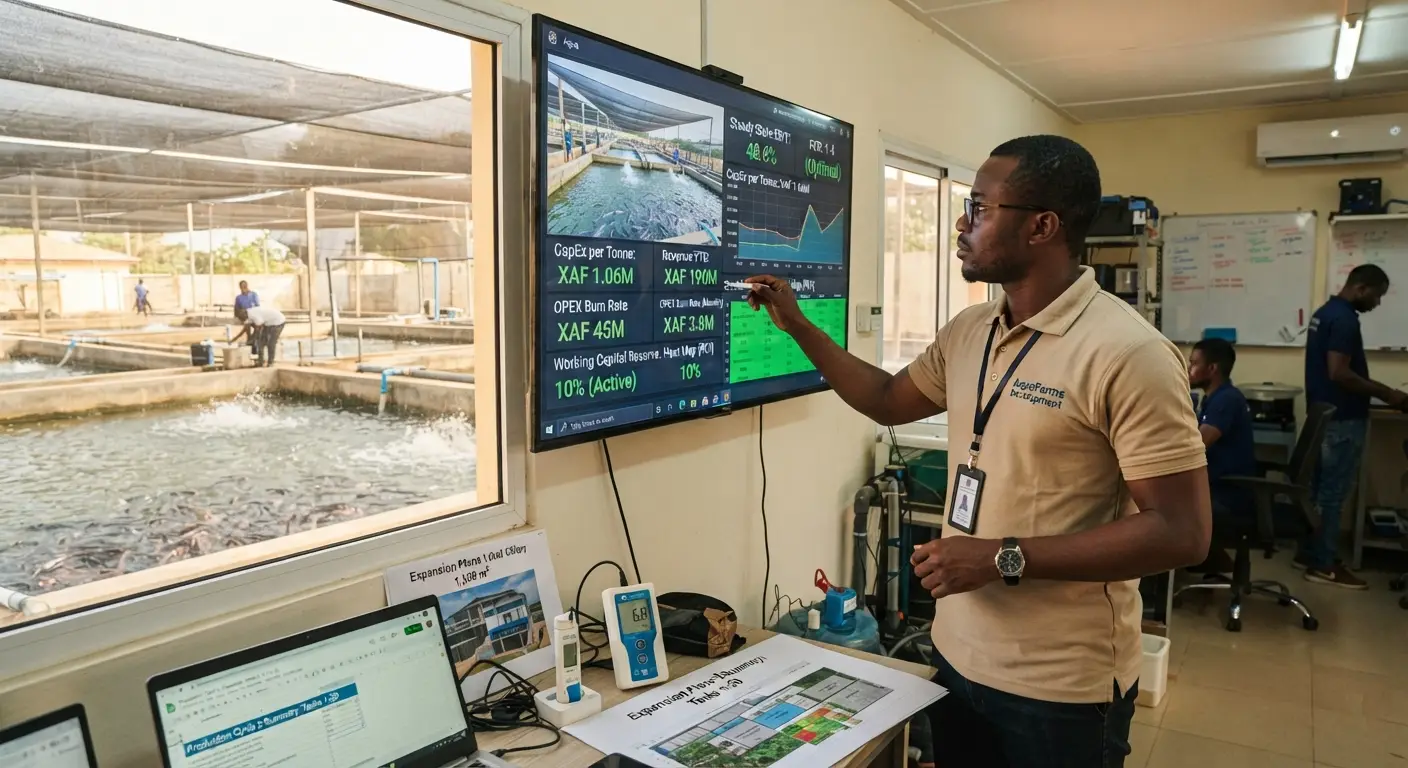
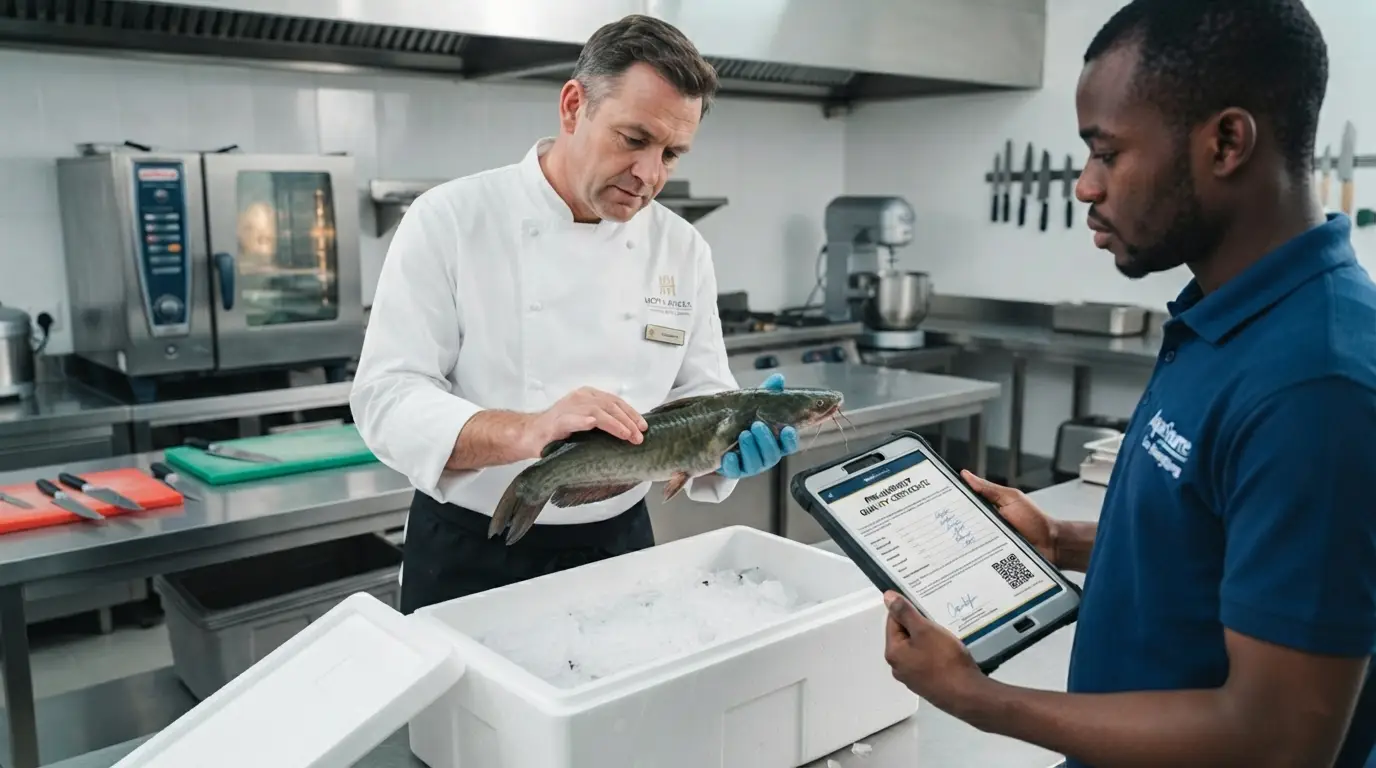
The catfish farm that produces 75 tonnes per year but has no pre-arranged buyers for its harvest is not a profitable business — it is an expensive problem. Fish harvested without committed buyers must either be sold immediately at whatever price the nearest buyer offers (typically the lowest price available in the market on that day) or held live in increasingly stressed and expensive holding conditions while the farm manager searches for a buyer. In a business where feed cost represents 60–70% of operating expenses, and the production cycle runs 18–20 weeks, recovering the full commercial value of that investment at harvest is not automatic — it requires the same systematic effort that production management receives, applied to market development and buyer relationship management.
The gap between commodity catfish pricing (XAF 1,500–2,000 per kilogram wholesale, live weight) and premium channel pricing (XAF 3,000–5,000 per kilogram for processed fresh product in hotel and restaurant supply) is 100–200% — a difference that, as the business plan analysis established, is the margin between a moderately profitable operation and a highly profitable one. This price gap is not bridged by producing better fish than competitors (though consistent quality is a prerequisite for premium access). It is bridged by building the buyer relationships, supply chain logistics, and quality assurance documentation that premium buyers require to commit to consistent volume purchases at premium prices.
This guide covers every market channel available to commercial catfish producers in West and Central Africa — the specific buyer categories, how they evaluate suppliers, how to develop relationships with them, what price structures to negotiate, and how to manage the ongoing commercial relationship once established. It also covers the value-addition strategies that allow farms without premium market relationships to capture additional margin from the same fish production through processing, smoking, and direct-to-consumer approaches.
Understanding the Catfish Market Landscape
The Price Tier Structure
West and Central African catfish markets are not a single undifferentiated market — they are a layered structure of distinct buyer categories, each with different price points, different quality requirements, different volume commitments, and different relationship dynamics:
Tier 1 — Live fish wholesale market (lowest price, highest volume, lowest relationship requirement):
- Price range: XAF 1,200–2,000/kg live weight
- Buyers: wholesale traders, market aggregators, itinerant buyers
- Volume: unlimited — the wholesale market absorbs any volume
- Quality requirement: live fish, no specifications beyond survival
- Relationship: transactional — no commitment, price negotiated at point of sale
Tier 2 — Urban retail and butcher supply (mid-range price, moderate volume):
- Price range: XAF 1,800–2,500/kg live or fresh-killed
- Buyers: urban fish butchers, retail market stallholders, neighborhood food shops
- Volume: 50–300 kg per delivery, consistent weekly schedule
- Quality requirement: live or very fresh killed; uniform size preferred
- Relationship: semi-regular; price-sensitive but values reliability
Tier 3 — Institutional food service (hotel, restaurant, catering) — premium price:
- Price range: XAF 2,800–4,500/kg for fresh whole or processed
- Buyers: hotel purchasing managers, restaurant chefs, caterers
- Volume: 20–200 kg per weekly delivery, committed schedule
- Quality requirement: consistent size, freshness documentation, sometimes HACCP compliance
- Relationship: contractual or semi-contractual; quality and reliability valued over lowest price
Tier 4 — Supermarket and formal retail (premium price, high documentation requirement):
- Price range: XAF 3,500–6,000/kg for fresh packaged product
- Buyers: supermarket chain procurement managers
- Volume: 50–500 kg per week, consistent supply
- Quality requirement: consistent graded size, packaging, labeling, food safety documentation, often cold chain verified
- Relationship: formal supply agreement; strictest quality and documentation requirements
Tier 5 — Export markets (highest potential price, highest compliance requirement):
- Price range: USD 3.50–8.00/kg CIF destination port (depends on form: live, fresh, frozen fillet, dried/smoked)
- Buyers: import distributors, diaspora food distributors, ethnic food specialty retailers
- Volume: container loads (minimum viable export volume typically 10+ tonnes per shipment)
- Quality requirement: export food safety certification (HACCP, country-of-origin documentation, phytosanitary certificate, NAFDAC/equivalent registration)
- Relationship: formal commercial contract; most demanding but most financially rewarding
The Market Development Sequence
The realistic market development pathway for a new commercial catfish operation:
Months 1–3 (pre-production): Identify and begin developing Tier 2–3 buyer relationships before any fish are produced — visiting potential institutional buyers, providing production schedule information, offering sample product sourced from other producers to demonstrate quality positioning.
Month 4–6 (first cycle): Begin sales in Tier 1 (wholesale market) to generate initial cash flow while Tier 2–3 relationships are being converted from interest to committed orders. The wholesale market is the guaranteed offtake channel — no relationship required, immediate payment, immediate cash flow.
Month 6–12 (first year): Progressively shift the sales mix from Tier 1 toward Tier 2–3 as institutional buyer relationships are established and confirmed through initial deliveries. Target 40–50% Tier 3 by end of Year 1.
Year 2 onward: Achieve the target 60% premium channel / 40% commodity channel mix that the business plan analysis established as required for target profitability. Begin developing Tier 4 relationships if quality documentation and processing capability allow.
The Live Catfish Market — Commodity Channel Management
How the Live Fish Wholesale Market Works
The live catfish wholesale market — the network of buyers at major city fish markets (Mile 12 in Lagos, Kado Fish Market in Abuja, Marché de Poisson in Douala, Marché Mokolo in Yaoundé) — operates on daily spot pricing that reflects supply and demand conditions on that specific day:
Price determination: Wholesale price on any given day is set by the negotiation between buyers (who know what they can sell that day to downstream buyers) and sellers (who have fish that must be sold and face holding costs if unsold). Oversupply — from multiple farms harvesting simultaneously, typically after major holidays — pushes prices to XAF 1,200–1,400/kg. Undersupply — from seasonal production gaps in the dry season — pushes prices to XAF 1,800–2,000/kg.
The harvest timing advantage: Farms that track market price patterns across the year and time harvests to avoid peak supply periods — and coincide with peak demand periods (major festivals, school resumption periods when household spending recovers) — consistently achieve 15–25% higher prices than farms that harvest on a production-determined schedule without market timing consideration.
Key market timing observations for West Africa:
| Period | Typical Market Condition | Strategic Implication |
|---|---|---|
| December 20 – January 10 | Peak demand (Christmas, New Year) | Premium prices — target major harvest here |
| January 15 – February 28 | Post-holiday demand trough | Avoid large harvests; hold if possible |
| March–April | Moderate demand; Ramadan/Easter premium | Moderate prices; some premium for specific buyers |
| May–July | Rainy season; moderate to good demand | Stable; plan harvests to avoid June price troughs in some markets |
| August–September | School resumption; increasing demand | Good timing for harvests |
| October–November | Building toward festive season | Prices rising; good harvest window |
Building Relationships With Wholesale Aggregators
Rather than selling to whatever buyer arrives at the market on harvest day, establishing relationships with 2–3 regular wholesale aggregators who commit to purchasing a defined volume at a defined price provides:
- Price predictability: Negotiate a forward price 1–2 weeks before harvest — avoiding the spot market price uncertainty of arriving with fish and no committed buyer
- Volume reliability: Aggregators with committed purchase relationships often absorb larger volumes than opportunistic spot buyers, allowing larger individual harvests
- Payment reliability: Established relationships typically come with clearer payment terms (cash on delivery vs. the credit extension that some spot buyers attempt)
How to identify and approach wholesale aggregators:
Visit the target wholesale market 3–4 times before the first planned harvest — observing which buyers consistently purchase large volumes, how they handle fish, where they distribute, and whether they represent restaurants and hotels (indicating higher-value downstream buyers that might pay more for quality). Introduce yourself as a producer with regular supply, state your expected harvest volumes and frequency, and propose a trial purchase at current market price to establish the relationship.
Hotel and Restaurant Supply — The Premium Channel
Why Institutional Food Service Is the Highest-Value Channel
The hotel and restaurant market in West and Central African cities — particularly the formal hotels (international chain and upscale local hotels) and mid-to-high-end restaurants that serve Lagos Island, Victoria Island, Ikoyi, Lekki, Douala, Yaoundé, Accra Airport area, and similar premium urban zones — represents the highest-value catfish market channel accessible to most commercial producers without export capability.
These buyers pay XAF 2,800–4,500/kg for fresh catfish because:
- Consistency: They need the same size (typically 600–900 g) at the same time every week — their menu planning and food cost management depend on it
- Quality assurance: A luxury hotel cannot serve off-flavor fish to guests paying XAF 50,000+ per night — they need a supplier whose fish is consistently clean and fresh
- Reliability: A restaurant that runs out of catfish on Friday evening because their supplier failed to deliver has a customer experience and revenue problem — they value suppliers who deliver on time, every time, more than they value the lowest possible price
A farm that can consistently deliver these three attributes — consistent size, verified quality, reliable schedule — commands a premium that reflects the value of the supply reliability these buyers need and struggle to find.
The Hotel and Restaurant Buyer Development Process
Step 1: Identify target buyers
Research and list every hotel and restaurant in your target geography that serves catfish dishes. The identification sources:
- Hotel directories and booking platforms (most hotels list their restaurants)
- Restaurant review platforms (Google Maps, TripAdvisor local listings — restaurants that feature catfish on their menu are immediately identifiable)
- Direct market research — visiting restaurants and asking what fish they serve and how frequently
- Industry association networks — hospitality industry associations in Lagos, Douala, Accra maintain member lists
Prioritize the 10–15 highest-volume potential buyers — typically 4–5 star hotels, hotel-restaurants with high occupancy, and established mid-to-high-end restaurants — rather than attempting to develop all potential buyers simultaneously.
Step 2: Identify the correct contact
The purchase decision for fresh fish in a hotel is made by either:
- The Executive Chef (for independent restaurants and boutique hotels) — who controls menu decisions and has the clearest view of quality requirements
- The Food and Beverage Manager (for larger hotels) — who manages supplier relationships and purchase contracts
- The Procurement Manager (for large hotel chains) — who handles supplier approval and contracting
Cold calls to hotel reception or restaurant managers rarely reach the decision-maker. A better approach: visit the restaurant during a quiet service period (mid-afternoon), ask to speak with the chef, and introduce yourself directly as a local catfish producer with a specific value proposition.
Step 3: The value proposition presentation
The buyer development conversation should address the specific problems hotel and restaurant buyers face with their current catfish supply:
“What are the biggest challenges you face with your current catfish supplier?”
Common answers will include: inconsistent size, quality variation, unreliable delivery, inability to guarantee quantity when needed most (holidays, events), no quality documentation.
Your value proposition should specifically address the problems the buyer articulates — not a generic presentation of your farm. If inconsistent size is the problem, demonstrate your grading capability. If quality documentation is the requirement, present your HACCP monitoring records and pre-harvest testing protocol. If delivery reliability is the issue, explain your harvest scheduling system and commitment to delivery windows.
Step 4: The trial delivery
The trial delivery is the most important single event in the premium buyer relationship development process. Do not attempt to negotiate price or volume commitment before the buyer has experienced your product and service:
- Deliver a trial quantity (typically 15–30 kg) on the buyer’s specified day and time
- Present the fish in the form the buyer prefers (live in oxygenated transport, or fresh-iced whole/gutted)
- Include a simple product information sheet: farm name, location, production system, the fact that the fish has been pre-harvest tested for off-flavor (if applicable), and your contact information
- Follow up 24–48 hours after delivery to ask about quality and whether the chef would like to proceed with a regular supply arrangement
Step 5: The supply agreement
Once the trial delivery is confirmed as satisfactory, formalize the arrangement — even if informally:
- Agreed weekly volume (minimum and maximum)
- Fish size specification (e.g., 600–900 g, or 900 g–1.2 kg)
- Delivery day and time window
- Price basis: fixed price, or price band (e.g., ±5% of the agreed base price), or market-indexed
- Payment terms (typically 7–14 days for hotel supply in West Africa)
A formal written supply agreement is not always expected in initial institutional supply relationships, but documenting the key terms in a written summary email after the verbal agreement provides a reference point for both parties.

Selling to Local Processors
The Processor Market — Scale and Value-Addition
Local fish processors — small-to-medium enterprises that purchase live or fresh catfish from farms and process them into smoked, dried, or value-added products — represent a channel that combines higher-than-wholesale prices with the volume absorption capacity that individual institutional buyers cannot match.
Types of local processors:
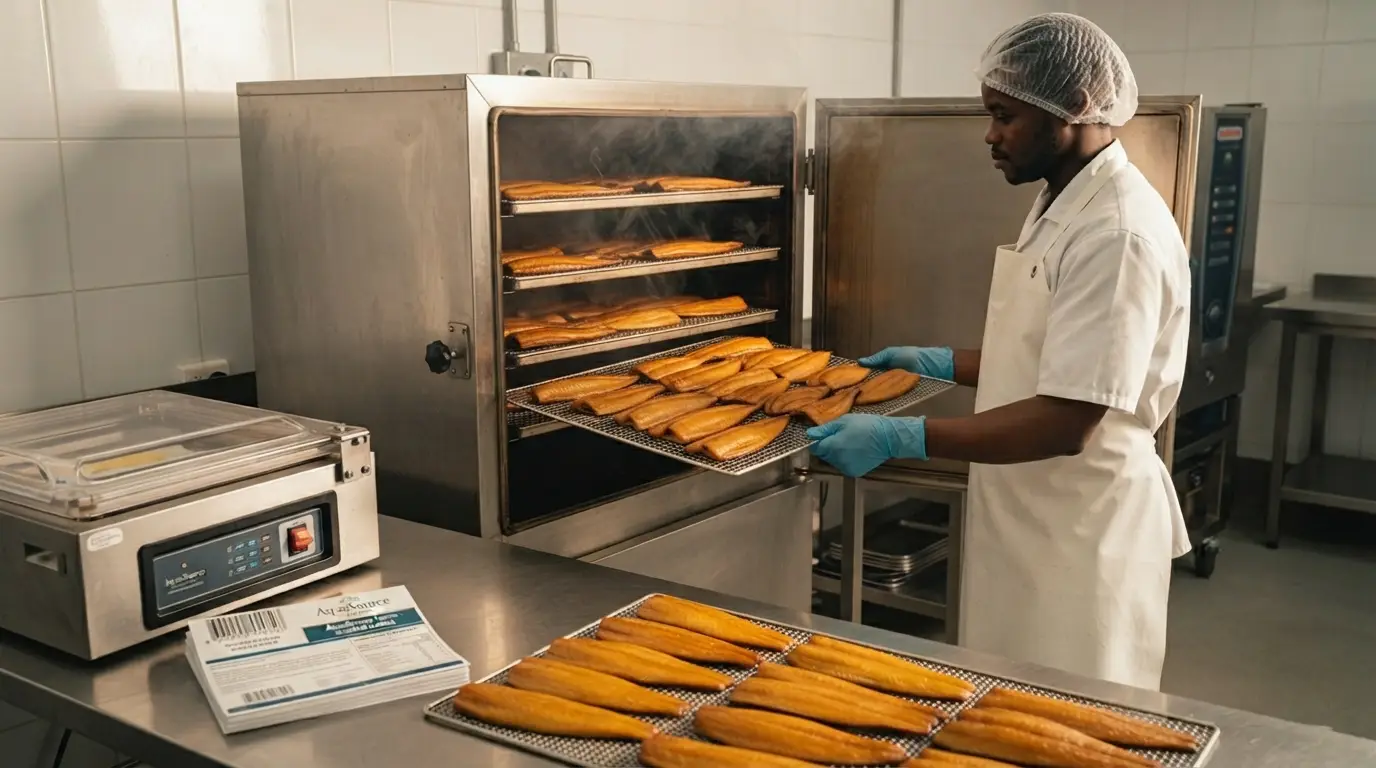
Smoked fish processors: The most significant processor category for catfish in West and Central Africa — operations that purchase live or fresh catfish in volumes of 500 kg to several tonnes per week, smoke them using traditional charcoal or wood-fired kilns or modern mechanical smokers, and distribute the finished smoked product through wholesale and retail channels across wide geographic areas. These processors represent a reliable offtake channel for large production volumes and pay a premium above live fish wholesale price (typically 15–30% above, or XAF 1,800–2,600/kg fresh weight equivalent depending on the processor’s margin structure).
Fresh fillet processors: Operations that fillet and package fresh catfish for retail sale — primarily supplying supermarkets and urban food shops. These processors require consistent supply, uniform fish size for packaging standardization, and clean product without off-flavor. Pay higher prices than smoked fish processors (typically XAF 2,200–3,000/kg fresh whole weight equivalent) for the quality required.
Dried/salted catfish processors: A smaller market segment — dried or salted catfish for use as a flavoring ingredient in soups and stews. Typically purchase at commodity prices but in large volumes.
Developing Processor Relationships
Processor supply contracts — where the processor commits to purchasing a defined minimum volume per week at a defined price or price formula — provide the supply chain stability that allows production scale-up. Unlike institutional buyers who manage small weekly volumes, a single large processor relationship can absorb the entire output of a 500 m³ operation.
The processor relationship negotiation:
Price formula: Many processor supply arrangements use a formula rather than a fixed price — tying the purchase price to a reference market price index (the prevailing wholesale market price at the major urban market) plus a premium for quality or supply reliability. This formula approach allows both parties to participate in market price movements rather than locking either into a fixed price that becomes unfavorable when market conditions shift.
Minimum volume commitment: The processor commits to purchasing a minimum volume per week (100 kg, 500 kg, or whatever volume the processor’s operations can consistently absorb). The farm commits to delivering this volume reliably. Volume above the minimum may be at the processor’s discretion to purchase or decline.
Quality specification: Define the minimum fish size, freshness standard, and any off-flavor testing requirement explicitly — to avoid disputes at delivery about whether the specific batch meets the agreed specification.
Wholesale Fish Distribution — Building a Distribution Network
The Distribution Role
A commercial catfish farm that is also its own distributor — delivering directly to multiple buyers across a city — captures the distributor’s margin but incurs the distributor’s costs (vehicle, driver, fuel, cold chain equipment, credit management for multiple accounts). At 500 m³ scale with 75,600 kg annual production, the volume justifies building a small direct distribution capability.
The direct distribution economics:
At XAF 2,640/kg average blended price (the business plan assumption), the gross margin between farm-gate price (approximately XAF 1,600/kg after production cost) and delivery price is XAF 1,040/kg. Distribution cost (vehicle, driver, fuel, ice) for a 200 kg delivery to 5 stops in the same city: approximately XAF 40,000–60,000 = XAF 200–300/kg. Net margin from distribution function: XAF 740–840/kg — a significant contribution that rewards the operational investment in a distribution capability.
Building a delivery route:
Consolidate deliveries geographically — all hotel and restaurant clients on one route delivered on the same day by the same vehicle. A well-designed route for a 500 m³ operation might deliver 150–300 kg to 5–8 institutional clients twice per week, generating XAF 396,000–792,000 in weekly gross revenue from that route.
The refrigerated vehicle advantage: A small refrigerated vehicle (light truck with refrigerated box body, cost XAF 12,000,000–20,000,000) extends the delivery radius to 100–150 km for killed fresh product, allows larger loads without ice management complexity, and presents a professional food safety image to institutional buyers that a motorbike with ice-packed styrofoam boxes does not. At 500 m³ scale and above, the refrigerated vehicle investment is recovered within 12–18 months from the distribution margin it enables.
Value-Added Fish Products — Capturing Additional Margin
Why Value Addition Matters
Value addition — converting whole live catfish into processed products (fillets, smoked, dried, seasoned) — is the strategy that captures additional margin from the same production volume and opens market channels (supermarkets, exports, diaspora markets) that are inaccessible to producers selling only live or fresh-whole fish.
The value-addition multiplication factor for African catfish:
| Product Form | XAF/kg Basis | Basis | Value Multiplier vs Live |
|---|---|---|---|
| Live fish (farm gate) | 1,600–2,000 | Live weight | 1.0× |
| Fresh whole (killed, iced) | 1,900–2,500 | Live weight equivalent | 1.2× |
| Fresh whole gutted | 2,200–3,200 | Gutted weight | 1.4× |
| Fresh fillet (skin-on) | 4,000–6,000 | Fillet weight | 2.5× |
| Hot smoked whole | 3,500–6,000 | Smoked weight | 3.0× |
| Hot smoked fillet | 6,000–10,000 | Smoked fillet weight | 5.0× |
| Dried/stockfish equivalent | 4,000–8,000 | Dried weight | 3.5× |
The value multiplication looks compelling — but the yield losses and processing costs must be incorporated into the calculation. A 1 kg live catfish produces approximately:
- 960 g gutted whole fish (4% gut removal)
- 380–400 g fresh fillet (38–40% fillet yield)
- 250–280 g smoked fillet (25–28% yield from live weight)
- 180–200 g dried smoked product (18–20% yield)
The realistic value-addition margin for smoked fillet:
Revenue: 1 kg live fish → 265 g smoked fillet × XAF 8,000/kg = XAF 2,120. Production cost of 1 kg live fish: XAF 1,357 (from business plan). Smoking cost (fuel, labor, packaging per kg): XAF 350–500. Net margin from smoked fillet: XAF 263–413 per kg of live fish processed
Compared to direct fresh sale: Revenue XAF 2,640 − Cost XAF 1,357 = Net margin XAF 1,283 per kg live fish sold fresh
The smoked product produces less net margin per kilogram of live fish processed than direct fresh institutional sales — because the fillet yield loss and processing cost reduce the effective value recovery. However, smoked product:
- Has a shelf life of weeks rather than days — allowing marketing at distances and through supply chains inaccessible to fresh fish
- Opens entirely different market channels (dried fish markets, diaspora export, online sales) with different competitive dynamics
- Provides an outlet for below-grade fish (slightly off-specification size, minor defects) that cannot be sold in premium fresh channels
The hybrid strategy: Process below-grade and surplus production (fish above market weight, fish from tanks with slightly below-target growth rate, fish that miss the optimal harvest window) into smoked product for the dried fish market, while selling premium-grade, on-target-size fish fresh to institutional buyers at maximum value.
Smoked Catfish Production — Basic Requirements
For operations adding a smoking capability:
Traditional clay/earth kiln: Capital cost XAF 200,000–500,000; capacity 100–500 kg fresh fish per 8-hour smoking session; fuel is wood or charcoal at XAF 50–80 per kg smoked product; labor-intensive and weather-sensitive. Appropriate for small volumes as a market test before capital investment in mechanical smoking.
Mechanical rack smoker (stainless steel): Capital cost XAF 2,000,000–8,000,000 for commercial-scale units; capacity 200–1,000 kg per session; more consistent product quality; food safety-compliant surfaces. Appropriate for operations targeting formal retail and export markets where HACCP compliance is required.
Direct-to-Consumer Marketing
The Direct-to-Consumer Opportunity
Direct-to-consumer (DTC) sales — where the farm sells directly to end consumers rather than through any intermediary — offers the highest margin per kilogram of any sales channel but requires the most marketing effort and consumer relationship management.
DTC channels available to catfish farms:
Farm gate sales: Consumers visit the farm directly to purchase live fish. Minimal marketing effort required once word-of-mouth establishes the farm’s reputation in the local community. Best for farms accessible to residential areas — peri-urban operations within 10–15 minutes of substantial residential neighborhoods. Typical price: XAF 2,200–3,000/kg (above wholesale but below premium institutional, reflecting the consumer’s willingness to pay for freshness and the farm visit experience).
WhatsApp and mobile phone order networks: A farm with a WhatsApp group or broadcast list of regular customers can take orders 24–48 hours before harvest, confirm the specific quantity of each order, harvest exactly what is needed, and distribute directly to customers at agreed locations. This approach achieves premium pricing (XAF 2,500–3,500/kg) with near-zero marketing cost once the customer base is established. Requires reliable mobile connectivity and consistent product quality to maintain customer retention.
Social media marketing (Instagram, Facebook): Visual platforms where the farm’s production system, quality practices, and fresh products are documented and shared build a follower base of potential consumers in the target city. Content that performs well includes: tank harvesting videos, quality verification (cook test results, feeding behavior observation), behind-the-scenes production management, and customer testimonials. Social media marketing requires consistent content creation effort but has very low direct financial cost and can develop a customer base of hundreds of regular buyers over 6–12 months of active management.
Community subscription models: A regular subscription — where consumers pay a fixed monthly amount to receive a fixed weight of fresh catfish (e.g., XAF 15,000 per month for 5 kg delivery twice monthly) — provides the farm with predictable, pre-committed revenue and the consumer with regular fresh fish at a price below premium retail. This model works best for farms with refrigerated delivery capability and the administrative system to manage subscription billing and delivery scheduling.
Farmers markets and urban food markets: In cities where farmers markets are established (Lagos, Accra, Nairobi) or developing, a weekly farm stall allows direct consumer interaction, premium pricing (XAF 2,800–4,000/kg for live fish or freshly processed product), and brand building that supports other marketing channels. Market stall fees are typically XAF 5,000–25,000 per market day, manageable against the premium pricing available.
Export Markets — The Highest-Value but Most Complex Channel
The Diaspora and Export Market Opportunity
African catfish (Clarias gariepinus) is consumed by West African diaspora communities in Europe, North America, and other regions — communities that have a strong cultural preference for the species they grew up eating and are willing to pay premium prices for imported fresh or frozen African catfish. This market exists and is not adequately supplied by domestic production:
- UK diaspora market: significant West African community in London, Birmingham, Manchester
- US diaspora market: significant Nigerian, Ghanaian, and Cameroonian communities in Houston, Atlanta, New York, Washington, DC
- European market: Netherlands, Belgium, Germany, France with substantial West African populations
Documented export price ranges: Live catfish exported by air: USD 7–12/kg CIF destination; frozen whole catfish: USD 3.50–5.50/kg CIF; frozen fillet: USD 6–9/kg CIF.
The export requirements barrier: Export is the most financially rewarding channel and the most compliance-demanding:
- National food safety authority registration (NAFDAC in Nigeria; ANRQ in Cameroon)
- Phytosanitary certificate (issued by government veterinary authority)
- HACCP certification of the processing facility
- Cold chain documentation from farm to aircraft to destination
- Importer registration in the destination country
- Minimum viable export volume for commercial feasibility (typically 500 kg minimum per air freight shipment; 10+ tonnes for sea freight)
The realistic export pathway for a 500 m³ operation:
Direct export from a single 500 m³ operation is typically not economically viable — the volume is insufficient for sea freight, and air freight cost per kilogram is only justified by the highest-value products (live fish, premium fresh fillet). The more accessible pathway is:
- Supply to an export aggregator: a company that purchases from multiple farms, aggregates to export-viable volumes, handles all compliance, and sells into export markets — paying a premium above domestic wholesale (typically XAF 2,500–3,500/kg) for compliant product
- Collective export: a producer group that aggregates production across multiple farms, pools the compliance cost, and exports collectively — requiring producer group governance and logistics coordination that is organizationally challenging but financially viable at combined volumes
Pricing Strategy and Negotiation
Setting Prices That Reflect Value, Not Just Cost
The fundamental pricing principle for premium catfish market channels: price should reflect the value delivered to the buyer, not the cost of production plus a margin. A hotel that saves XAF 300,000 per month in rejected product, returns, and chef time from supplier quality problems by switching to a reliable supplier with documented quality management is receiving XAF 300,000 per month in value beyond the fish itself — and should be willing to pay a price that captures a share of this value.
The cost-plus pricing trap: Many farms price their product at production cost + target margin, then discover that this price is either above what the market will pay (overpriced for commodity channels) or well below what premium buyers would pay for the quality and reliability being delivered (underpriced for premium channels). Market-based pricing — anchored by what premium buyers pay for competitive alternatives, not by production cost — captures more of the value created.
Price negotiation principles for institutional supply:
Never lead with price: Open negotiations with a discussion of quality, reliability, and supply consistency — establish the value proposition before discussing the number. A buyer who is sold on your quality and reliability before the price is mentioned will pay more for it than a buyer whose first question is answered with a price.
Anchor at the premium end: In the first price discussion, anchor above your target price — institutional buyers expect to negotiate downward. Anchoring at your actual target leaves no negotiation room and results in a final price below target.
Offer volume for price tradeoffs: If a buyer resists the stated price, offer a volume-based concession — “at XAF 3,000/kg for 50 kg/week I can hold this price; for 100 kg/week I can offer XAF 2,800/kg.” This converts a price negotiation into a volume commitment that benefits the farm’s production planning.
Build in price review mechanisms: Agree on an annual or semi-annual price review mechanism rather than committing to a fixed price indefinitely — particularly important given feed cost volatility that can change production economics significantly over 12 months.
Building a Marketing Calendar
Integrating Production and Market Planning
A marketing calendar — planning the sales activity for each month of the year, aligned with the production schedule — prevents the reactive selling that most farms fall into when a tank approaches harvest weight, and the search for a buyer begins with urgency rather than strategy.
The annual marketing calendar structure:
| Month | Production Event | Marketing Activity | Target Outcome |
|---|---|---|---|
| January | Tank 1–3 restocking | Follow up on December holiday sales; review buyer feedback | Confirmed Q1 supply agreements |
| February | Grow-out monitoring | Attend fisheries association meeting; visit 2 new potential hotel buyers | 2 new buyer contacts established |
| March | Pre-harvest testing (Tank 4) | Confirm April delivery schedule with existing buyers; negotiate Easter pricing | Confirmed Easter period deliveries at seasonal premium |
| April | Tank 4–5 harvest | Easter holiday deliveries; new buyer trial deliveries | 1–2 new buyer trials completed |
| May | Tank 1–3 monitoring | Review Q1 performance; update production schedule | Financial review; adjust Q2 plan |
| June | Pre-harvest testing (Tank 1–3) | Confirm July delivery schedule; approach smoked fish processor for surplus volume | Processor relationship confirmed |
| July | Tank 1–3 harvest | Institutional deliveries + wholesale for surplus | Mixed channel sales at target split |
| August | Tank 4–7 restocking | School resumption messaging to WhatsApp customer list | Direct-to-consumer sales campaign |
| September | Grow-out monitoring | Research and approach new hotel accounts for Q4 season | Q4 premium buyer pipeline |
| October | Pre-harvest preparation | Confirm Christmas/New Year supply commitments with buyers; lock in pricing | Holiday season supply confirmed |
| November | Tank 1–5 harvest | Pre-festive season deliveries at peak pricing; social media campaign | Maximum premium pricing period |
| December | Tank 6–10 harvest | Christmas and New Year deliveries; year-end review with key buyers | Full festive season capture |
Summary
Market development is not an activity that follows production success — it is a parallel and equally important management function that determines whether production success translates into financial success. The catfish farm that has developed relationships with 4–5 institutional buyers for 60% of its production, 2 wholesale aggregators with committed volumes for 30%, and a direct-to-consumer base absorbing 10%, is insulated from the market access failures that cause technically competent catfish farms to sell excellent fish at commodity prices indefinitely.
The specific channels — live wholesale market for volume and cash flow reliability, hotel and restaurant supply for premium pricing and margin, local processors for large-volume offtake, direct-to-consumer for maximum per-kg margin, value addition for product diversification and outlet for below-grade product — each require distinct development approaches, relationship management disciplines, and quality/logistics capabilities. No single channel is sufficient alone. The combination that matches the farm’s production scale, management capacity, geographic market access, and quality capability is the marketing strategy worth building.
The 100–200% price premium between commodity wholesale and premium institutional channel is not luck or superior fish genetics. It is the product of systematic market development effort, quality management that earns buyer trust, and the supply reliability that makes buyers willing to pay a premium for the certainty of consistent, quality supply they cannot find elsewhere. Build that reputation deliberately, one delivery at a time.