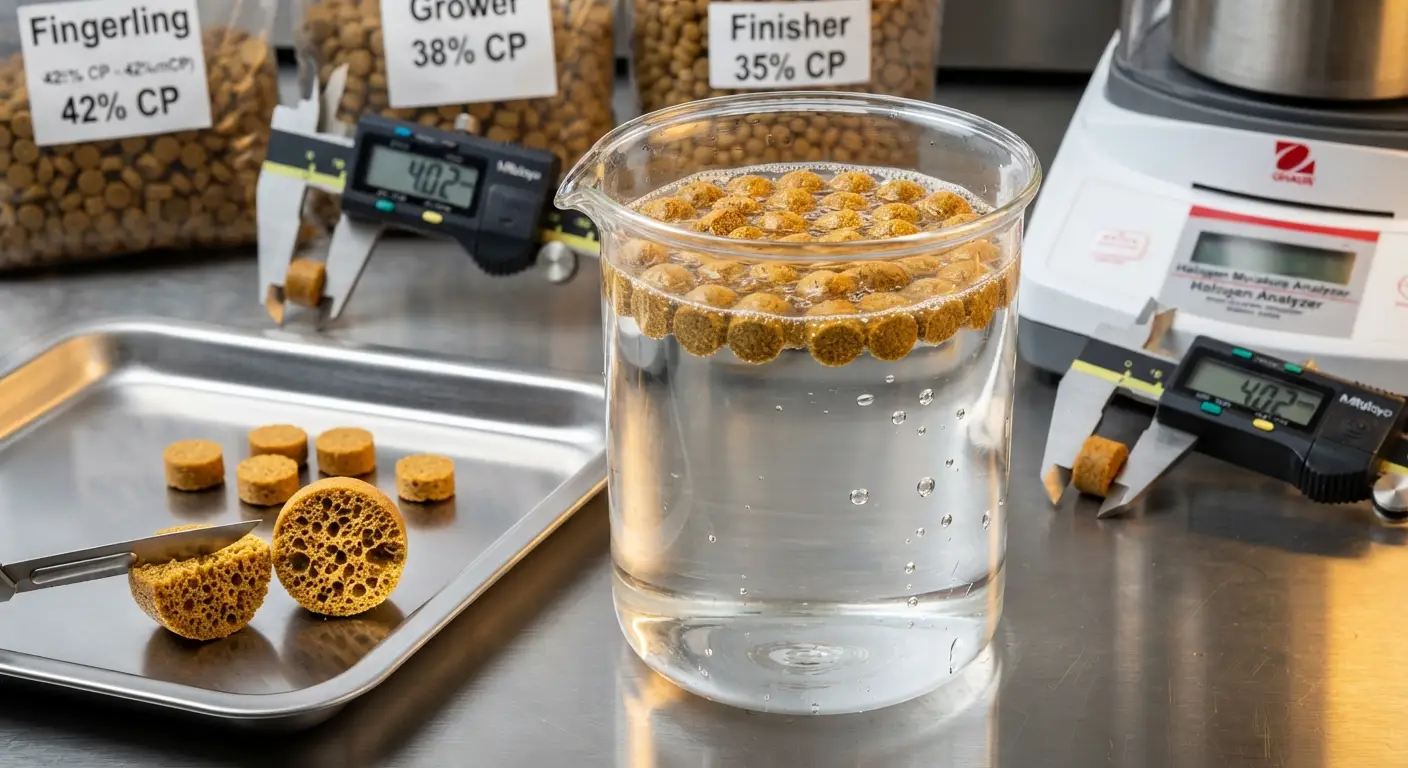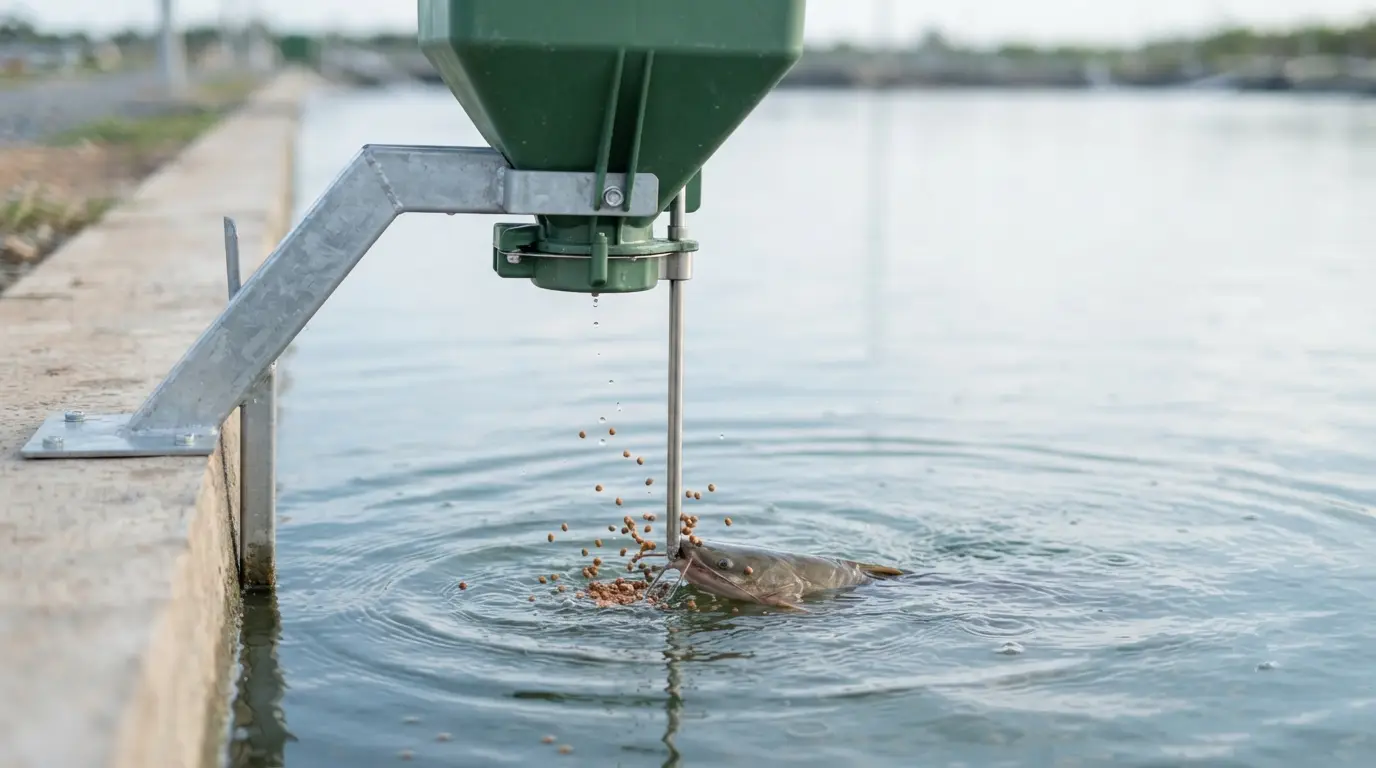
Walk into any catfish feed supplier’s premises in Lagos, Kano, Douala, or Accra, and you will find both floating (extruded) pellets and sinking (compressed or cold-pressed) pellets on the shelves. Ask the supplier which is better, and you will typically receive a confident answer in favor of whichever product they sell most of, or whichever the most prominent local farmers currently use. Neither answer reflects the actual basis for the choice, which is not a matter of one type being universally superior but of which type is most appropriate for a specific farm’s production system, fish density, management capability, and economic context.
The differences between floating and sinking pellets are not cosmetic — they originate in different manufacturing processes that produce feeds with different physical properties, different water stability characteristics, different digestibility profiles, and different interactions with the fish’s natural feeding behavior. A floating pellet that performs excellently in a concrete tank system with twice-daily attended feeding may perform poorly in an earthen pond with an inconsistent feeding schedule. A sinking pellet that delivers adequate nutrition at low cost in a large earthen pond system will produce unacceptable feed waste and water quality problems in a high-density concrete tank.
This guide covers the manufacturing science that explains why floating and sinking pellets behave differently in water, the production performance implications of each type under different management conditions, and the specific decision criteria that identify which type is the better investment for a given operation.
Manufacturing Differences, Why the Process Determines the Product
Floating Pellets — Extrusion Technology
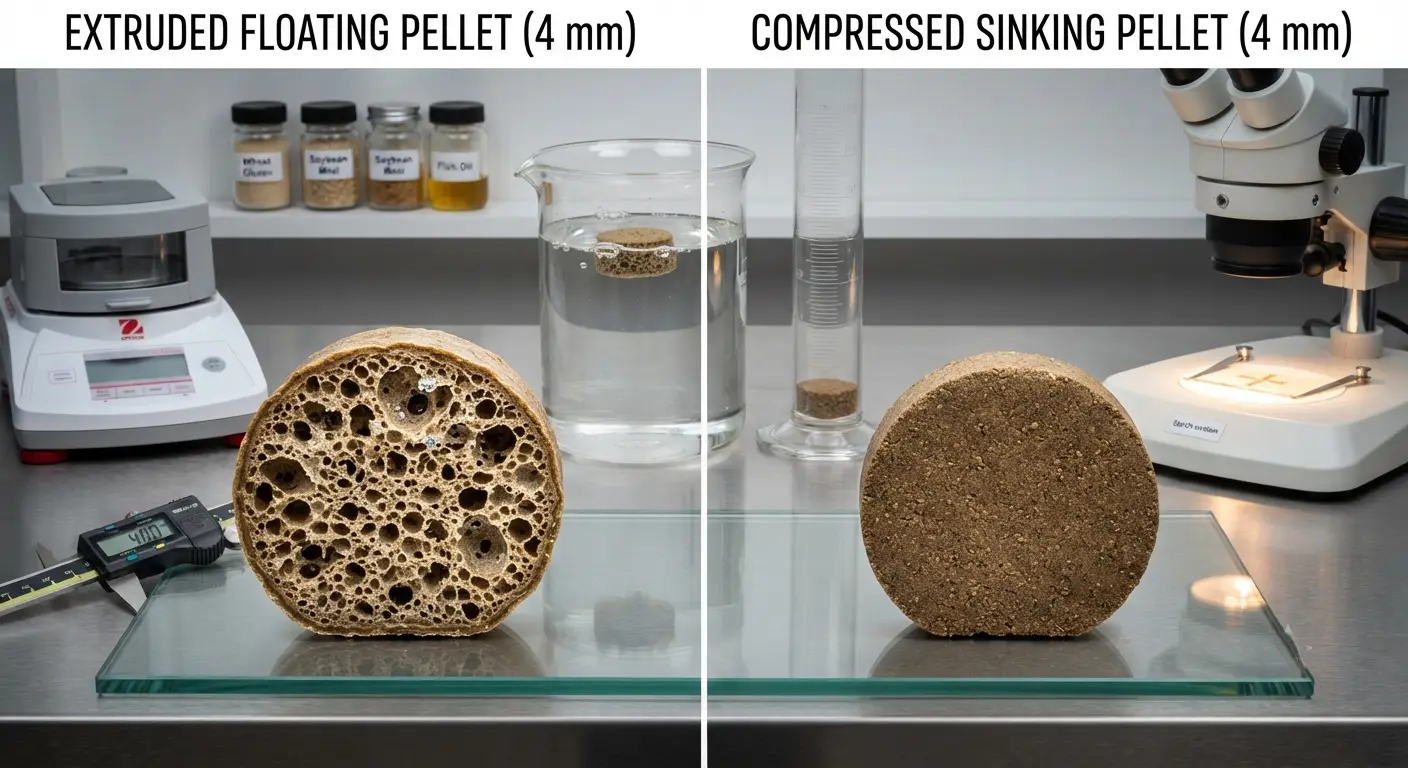
Floating pellets are produced by extrusion — a high-temperature, high-pressure manufacturing process in which the moistened feed mixture is forced through a die under extreme pressure and temperature (120–180°C), then rapidly released to atmospheric pressure. The sudden pressure drop causes the water in the feed matrix to flash to steam, expanding the pellet and creating the internal porous structure that traps air and makes the pellet buoyant. The high temperature simultaneously gelatinizes the dietary starch, increases protein digestibility, and sterilizes the feed of most bacterial contamination.
What extrusion does to the feed:
Starch gelatinization: Raw starch granules have a crystalline structure that catfish digestive enzymes can only partially break down — digestibility of raw starch in catfish is 40–60%. During extrusion, heat and moisture disrupt this crystalline structure (gelatinization), making the starch accessible to amylase enzymes. Gelatinized starch digestibility in catfish is 75–85% — a substantial improvement that directly contributes to lower FCR from extruded feeds.
Protein denaturation and digestibility: Moderate protein denaturation during extrusion improves the accessibility of amino acids to digestive proteases by unfolding protein molecules and exposing peptide bonds that were buried in the native protein structure. This improves protein digestibility by 5–10% compared to the same ingredients in a cold-processed feed.
Anti-nutritional factor reduction: Many plant protein sources contain anti-nutritional factors (protease inhibitors in raw soybeans, tannins in some legumes, gossypol in cottonseed) that reduce nutrient utilization. The high temperature of extrusion inactivates trypsin inhibitors and reduces the activity of other thermolabile anti-nutritional factors — improving the effective nutritional value of plant protein ingredients.
Lipid coating: After extrusion, liquid fats (fish oil, vegetable oil) can be vacuum-coated onto the pellet surface — adding dietary fat after the high-temperature extrusion step prevents the oxidation and volatile loss that occurs when fat is included in the feed mixture before extrusion. This coating capability allows higher fat inclusion without extrusion-associated oxidative damage.
The buoyancy mechanism: The porous internal structure of extruded pellets traps air, making the pellet less dense than water and therefore positively buoyant. Pellet density and buoyancy can be adjusted during extrusion by modifying temperature, pressure, moisture content, and die configuration — producing pellets that float at different rates and for different durations.
Sinking Pellets — Compression and Cold Pressing
Sinking pellets are produced by compression — the feed mixture is forced through a die at relatively low temperature and pressure, bonding the particles together through mechanical compression and the binding properties of starch and protein without the expansion and gelatinization of extrusion.
Standard compression (ring die pelleting):
The most common sinking pellet manufacturing method — a ring die with multiple radial holes surrounds a pair of rollers that force the feed mixture through the holes under high mechanical pressure. The emerging cylinders are cut to length by a rotating knife. Steam conditioning (exposing the feed mixture to steam at 60–90°C before pelleting) partially gelatinizes starch and activates natural binders.
Temperature during processing: 60–100°C — substantially lower than extrusion. This means less starch gelatinization (digestibility improvement is partial rather than complete), less reduction in anti-nutritional factors (particularly in soybean meal), and no sterilization of the feed at the level achieved by full extrusion.
Pellet density: The compressed, non-expanded pellet has no internal air pockets — it sinks promptly and remains on the bottom or in the water column. The sinking rate depends on pellet density and the fish species — catfish that are active bottom feeders by nature will locate sunk feed more readily than surface-feeding species.
Cold-pressed pellets (without steam conditioning):
Cold pressing without steam conditioning produces a less durable pellet with lower water stability. These pellets are often appropriate for hand-mixed on-farm feeds where a simple mechanical press is used — lower capital cost than an extruder, but also lower pellet quality.
Physical Performance Comparison
Water Stability
Floating pellets (extruded):
Extruded pellets have excellent water stability — the gelatinized starch matrix and the sealed, oil-coated surface resist water absorption. A quality extruded pellet maintains its structure for 30–60 minutes or more in water, allowing adequate time for fish to locate and consume it before it begins to break down. This stability means minimal nutrient leaching into the water before consumption — the nutrients stay in the pellet until the fish eats it.
Sinking pellets (compressed):
Water stability varies significantly by manufacturing quality and formulation — a well-manufactured compressed pellet with adequate binders (starch, wheat gluten, carrageenan) holds together for 15–30 minutes. A poorly formulated compressed pellet begins disintegrating within minutes of water contact, releasing fine particles that either settle to the bottom (where anaerobic decomposition creates oxygen demand and hydrogen sulfide) or remain suspended in the water column (increasing turbidity and biological oxygen demand).
Implication: In systems where feed consumption takes longer than 20–30 minutes after delivery (due to low stocking density, fish not locating the feed promptly, or large pond areas where feed distribution is uneven), a sinking pellet with poor water stability will have substantially higher nutrient leaching loss and greater water quality impact than a floating pellet of equal quality.
Feed Waste Detection and Management
The observation advantage of floating pellets:
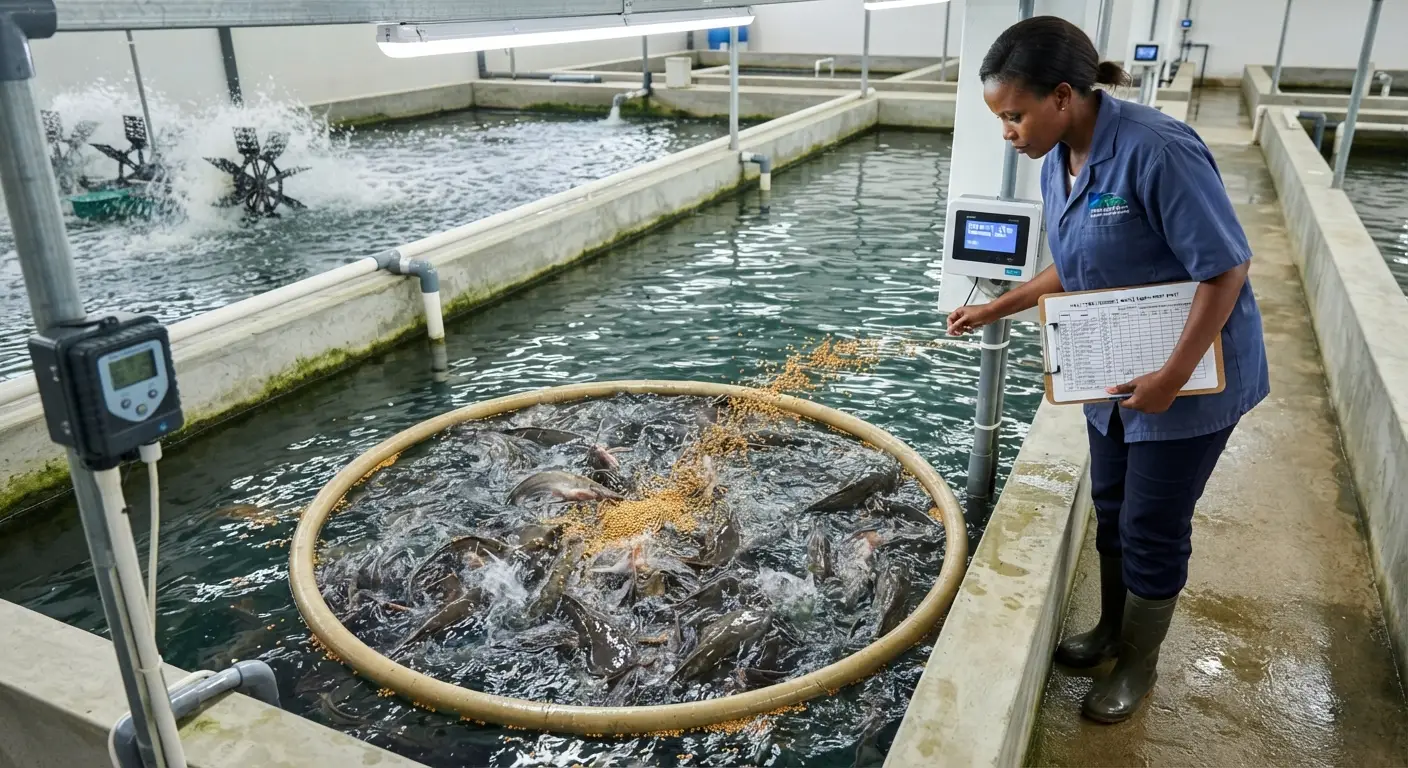
The most practically significant operational advantage of floating pellets over sinking pellets in concrete tank systems is the ability to observe uneaten feed at the water surface. A farm manager feeding floating pellets can see exactly how much feed has been consumed and how much remains after a defined feeding period — adjusting the subsequent ration accordingly.
When a tank of catfish that normally clears a feed ration in 15–20 minutes takes 40 minutes to consume the same ration, something has changed: water quality has declined, fish health has deteriorated, temperature has shifted outside the optimal range, or the fish are simply at a lower appetite state. The floating feed makes this change observable.
The invisible loss problem with sinking pellets:
Uneaten sinking feed settles to the tank or pond bottom where it is invisible from the water surface. The farm manager cannot observe whether the fish have consumed their full ration or have left a portion on the bottom — and the bottom-deposited uneaten feed decomposes, consuming oxygen and generating ammonia in exactly the location (the pond or tank bottom where dissolved oxygen is already lowest) where it creates the greatest water quality harm.
Studies comparing feed management with floating vs. sinking pellets in concrete tank systems consistently find 10–25% lower uneaten feed accumulation with floating pellets when feeding management is otherwise identical — purely because the visibility of surface feed allows real-time adjustment of the feeding rate.
Pellet Durability During Handling and Transport
Extruded pellets’ porous internal structure makes them more resistant to physical breakage during bagging, transport, and handling than the more brittle compressed pellets. Compressed pellets that break during transport produce fine dust (fines) that are too small for the fish to eat efficiently and contribute directly to water quality degradation when they enter the production system.
Practical purchasing implication: When receiving a feed delivery, check the proportion of fines (broken pellet fragments and dust) in each bag. Above 5–10% fines indicates either poor pellet quality or damage during handling — both resulting in reduced effective nutrient delivery and increased water quality impact. Quality extruded feeds typically have below 2–3% fines even after normal transportation handling.
Digestibility and Nutritional Value Comparison
The Digestibility Advantage of Extruded Feeds
As established in Part 1, the high-temperature extrusion process produces several digestibility improvements over cold-pressed or compression-pelleted feeds:
Starch digestibility: 75–85% (extruded) vs. 40–65% (compressed/cold-pressed) — a 20–40 percentage point advantage that directly contributes to lower FCR from the carbohydrate energy fraction.
Protein digestibility: Modest improvement from denaturation — 5–8% higher apparent digestibility in well-processed extruded feeds compared to equivalent compression-pelleted feeds from the same ingredients.
Anti-nutritional factor reduction: Particularly relevant for soybean meal inclusion — the trypsin inhibitor activity in soybean meal is substantially reduced by extrusion, allowing higher soybean meal inclusion rates without the growth-suppressive effect of trypsin inhibitor on digestive enzyme activity.
The practical FCR implication:
For a catfish grow-out operation targeting FCR of 1.4, the expected FCR difference between extruded and compressed feed from equivalent ingredient specifications is approximately 0.1–0.2 FCR units — representing 7–14% more feed required per kilogram of fish produced with compressed feed compared to extruded feed.
FCR comparison at scale (50 tonnes of fish per year):
| Feed Type | FCR | Feed Required (tonnes) | Feed Cost at XAF 600/kg | Cost Difference |
|---|---|---|---|---|
| Extruded floating | 1.4 | 70 tonnes | XAF 42,000,000 | Baseline |
| Compressed sinking | 1.55 | 77.5 tonnes | XAF 46,500,000 | +XAF 4,500,000 |
If the compressed sinking feed costs 15% less per bag than the extruded feed:
- Compressed feed cost: XAF 600/kg × 0.85 = XAF 510/kg × 77,500 kg = XAF 39,525,000
- Extruded feed cost: XAF 600/kg × 70,000 kg = XAF 42,000,000
In this scenario, the cheaper compressed feed actually costs less in total despite buying more tonnes — the lower per-kg price more than compensates for the higher FCR. This illustrates that the economic comparison between floating and sinking feeds is not a simple comparison of price per bag but a calculation of total feed cost per kilogram of fish produced — the only metric that correctly accounts for both price and FCR.
Feeding Behavior of African Catfish — Which Feed Type Matches Their Biology?
Natural Feeding Position of African Catfish
Clarias gariepinus is naturally a benthic feeder — its natural feeding behavior in wild environments involves locating food items on the substrate or near the bottom, using its barbels (chemosensory whiskers) to detect and locate prey by chemical cues. This bottom-feeding tendency might suggest that sinking feed would be more “natural” and therefore more readily consumed.
However, African catfish in commercial production adapt readily to surface feeding on floating pellets within days of training — the strong feeding motivation of a hungry, healthy catfish at commercial stocking density means that fish quickly learn to associate any location where food is delivered with a feeding opportunity. The conditioning to surface feeding is rapid and reliable.
Surface feeding observation advantage: Catfish feeding at the surface are visible — the farm manager can observe the number of fish participating in surface feeding, assess their body condition visually during the feeding response, and note any fish that are not participating (a health indicator). Fish feeding at the bottom of a tank or pond are not observable in any of these ways.
Feeding Behavior at Night
African catfish are primarily nocturnal feeders — peak feeding activity naturally occurs between 8:00 PM and 4:00 AM in undisturbed conditions. In commercial production, daytime feeding conditioning overrides the strict nocturnal preference, but the feeding response is typically strongest at the first morning feeding (after overnight fasting) and at evening feeding (aligned with the natural activity peak).
Floating feed and nocturnal feeding:
In tank systems where a night feeding is included in the program (particularly valuable for high-density systems approaching carrying capacity, where extended feeding windows maximize daily feed consumption), floating pellets allow the farm manager to add feed to a tank in the dark — the feed floats and remains available at the surface where fish can access it actively. Sinking feed added to a tank in the dark settles to the bottom where fish must locate it by chemoreception in the absence of the visual cue from moving pellets at the surface.
System-Specific Selection — When to Use Floating vs. Sinking
Concrete Tank Systems — Floating Pellet Advantage
In concrete tank systems with regular daily attendance and monitoring, floating pellets provide:
- Feed waste visibility: Uneaten feed at the surface is immediately visible, allowing real-time feeding rate adjustment
- Feeding behavior observation: Fish condition and health can be assessed during the surface feeding response
- Water quality protection: Floating pellets that are not consumed remain at the surface until they are removed — they do not settle to anaerobic bottom zones where decomposition is most damaging
- Better FCR: Higher digestibility from extrusion reduces feed cost per kg of fish at equivalent purchase price
Recommendation for concrete tank systems: Floating (extruded) pellets are the preferred choice in attended concrete tank operations with regular feeding supervision. The feed waste visibility and water quality protection advantages are most valuable in the controlled, high-density environment of concrete tanks.
Earthen Pond Systems — Context Determines the Choice
In earthen ponds, both pellet types have applications depending on stocking density, management intensity, and economic context:
For intensive pond systems (above 3 fish/m², daily attendance):
Floating pellets remain the better choice for the same reasons as concrete tanks — the surface observation advantage allows feeding rate management in a system where overfeeding has particularly serious water quality consequences (uneaten sinking feed in earthen ponds settles into anaerobic sediment that is much harder to remove than in concrete tanks).
For semi-intensive pond systems (1–2 fish/m², less intensive management):
Sinking pellets are a viable lower-cost option in semi-intensive earthen pond systems at lower stocking density where:
- The lower biomass per unit area produces less oxygen demand, reducing the water quality impact of moderate feed waste
- The larger pond area allows the natural pond biology (phytoplankton photosynthesis, zooplankton grazing) to compensate for some nutrient loading from feed waste
- The lower management intensity (visits every 2–3 days rather than daily) means that floating feed’s observation advantage is not consistently utilized anyway
For extensive pond systems (below 0.5 fish/m², minimal supplemental feeding):
Feed cost is the primary selection criterion — the lowest-cost nutritionally adequate sinking pellet or on-farm mixed ration may be appropriate where the natural pond food production contributes significantly to fish nutrition and the supplemental feed rate is low.
Large Earthen Ponds (Above 0.5 Hectare) — Special Considerations
In large earthen ponds, feed distribution presents a challenge with either pellet type:
- Floating pellets concentrate at the surface in the area where they are delivered — if fish are not already present at the delivery point, they must travel to find the feed, and wind can disperse floating pellets away from the intended feeding zone
- Sinking pellets settle in the delivery area and are available to benthic-feeding catfish without requiring them to be present at the surface at the moment of delivery
In large pond systems where consistent surface feeding conditioning is difficult to maintain (particularly in ponds where catfish density is low and the competitive feeding behavior that creates reliable surface responses in tanks is less pronounced), sinking pellets may actually produce less feed waste than floating pellets delivered to a location where fish are not concentrated.
On-Farm Feed Mixing — Floating vs. Sinking Context
Why On-Farm Mixing Typically Produces Sinking Pellets
As referenced in the pig series nutrition articles, on-farm feed mixing — using a hammer mill and pellet press to produce feed from purchased ingredients — is a cost-reduction strategy available to operations with sufficient scale to justify the equipment investment. The same principle applies in catfish farming.
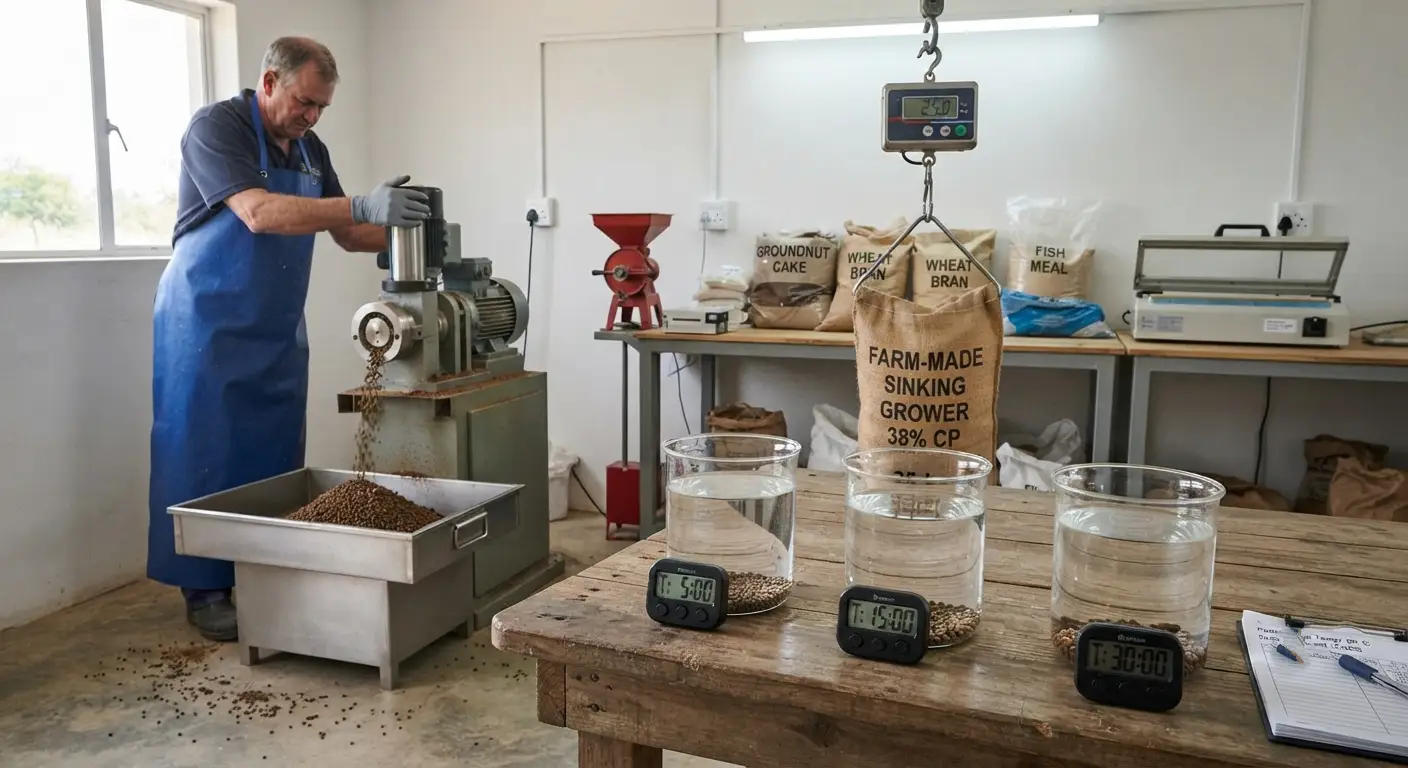
The practical constraint is that on-farm feed mixing equipment available at commercial catfish farm scale in West Africa (hand-operated or small electric pellet presses) produces cold-pressed sinking pellets — not extruded floating pellets, which require an industrial extruder that costs XAF 15,000,000–60,000,000 (USD 25,000–100,000) and is only economical at scales of 1 tonne or more per day.
On-farm mixed sinking feed quality optimization:
For farms using on-farm mixing, pellet quality (water stability, pellet hardness, fines content) is the primary quality parameter to optimize:
- Include wheat flour or wheat gluten at 5–10% of the diet as a binder — wheat gluten provides the elastic protein network that holds the compressed pellet together
- Steam condition the feed mixture before pressing where equipment allows — even brief steam exposure (60–80°C for 2–3 minutes) significantly improves pellet water stability compared to cold-pressing dry feed
- Dry pellets to below 12% moisture immediately after pressing — wet pellets stored in bags rapidly develop mold and are nutritionally compromised within days in tropical conditions
The Feed Cost Comparison for West African Operations
Indicative price comparison (2026, major West African cities):
| Feed Type | XAF/kg | USD/kg | Typical FCR | Feed Cost/kg Fish |
|---|---|---|---|---|
| Commercial extruded floating (branded, 40% CP) | 550–700 | 0.92–1.17 | 1.3–1.5 | XAF 797–975 |
| Commercial compressed sinking (40% CP) | 400–550 | 0.67–0.92 | 1.5–1.8 | XAF 680–880 |
| On-farm mixed sinking (formulated, 38% CP) | 250–350 | 0.42–0.58 | 1.6–2.0 | XAF 450–630 |
Feed cost per kg fish = feed price × FCR
The on-farm mixed feed, despite its worse FCR and lower protein digestibility, produces the lowest feed cost per kilogram of fish at scale — consistent with the principle established in the pig series nutrition cluster that manufacturing cost reduction through on-farm mixing captures a significant fraction of the feed cost, even when the on-farm product is nutritionally somewhat inferior to commercial alternatives.
Practical Purchasing and Evaluation Guidelines
Before Buying — Questions to Ask the Feed Supplier
For floating (extruded) feeds:
- What is the extrusion temperature used? (Above 120°C confirms full starch gelatinization)
- What is the water stability? (Ask for demonstrated float time in water)
- What form of vitamin C is used? (Ascorbyl phosphate = stable; ascorbic acid = may have degraded)
- What is the manufacture date? (Older than 3 months in tropical storage = reduced vitamin activity)
- What fish meal inclusion rate is used? (Ask for the ingredient list — fish meal in top three ingredients is a positive indicator)
For sinking (compressed) feeds:
- What is the water stability? (A pellet that disintegrates within 10 minutes in water is not acceptable)
- What steam conditioning process is used? (Steam conditioning improves digestibility and stability)
- What is the crude fiber content? (Above 6–7% indicates high inclusion of fibrous, low-digestibility ingredients)
- Has the feed been tested for aflatoxin? (Groundnut cake and maize, common in compressed feeds, are high-risk aflatoxin substrates)
The 30-Day Performance Evaluation
The objective determination of which feed delivers the best production performance for a given farm’s specific conditions requires a structured comparison:
- Stock two identical tanks (same size, same water quality management, same history) with fingerlings from the same batch, at the same density
- Feed Tank A with Feed Type 1 and Tank B with Feed Type 2 for 30 days
- Record: daily feed delivered (weighed), weekly sample weight of 20 fish per tank, any mortality
- Calculate FCR (feed delivered ÷ weight gained) and daily growth rate for each tank
- Calculate feed cost per kilogram of fish gained for each feed (FCR × feed price per kg)
This comparison, repeated over 2–3 production cycles, provides the definitive performance data for feed selection in that specific farm’s conditions.
Summary
The choice between floating and sinking catfish feed is a production economics decision, not a nutritional dogma. Floating extruded pellets provide superior digestibility, feeding behavior visibility, and water quality protection at the cost of a higher price per bag. Sinking compressed pellets provide lower cost per bag and are appropriate for lower-intensity systems, large earthen ponds, or operations where on-farm mixing makes commercial floating feed uneconomic.
The correct comparison is not price per bag — it is feed cost per kilogram of fish produced, which accounts for the FCR difference between feed types. When this calculation includes the water quality management cost difference (higher water quality deterioration from sinking feed waste in concrete tanks adds aeration and exchange water costs that partially offset the purchase price savings), the floating pellet’s total economic advantage in attended concrete tank systems is typically larger than the price-per-bag comparison suggests.
In earthen pond systems at moderate density, and in any system where on-farm feed mixing is viable at scale, sinking pellets deliver the lowest total cost of production and are the appropriate choice.
The next article completes the nutrition cluster by covering feed conversion ratio calculation, optimizing feeding schedules, and the management discipline that converts good feed into the FCR performance the nutrient specification promises.