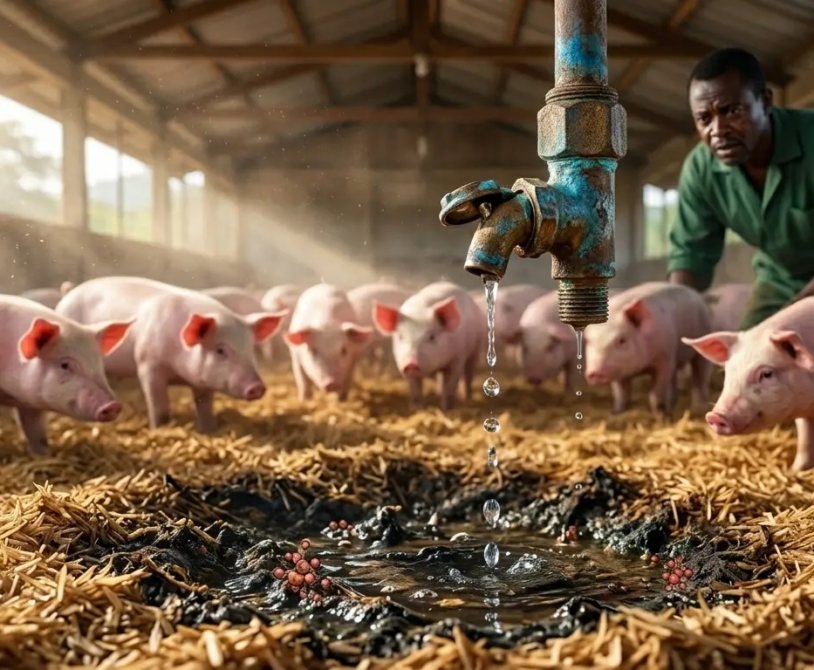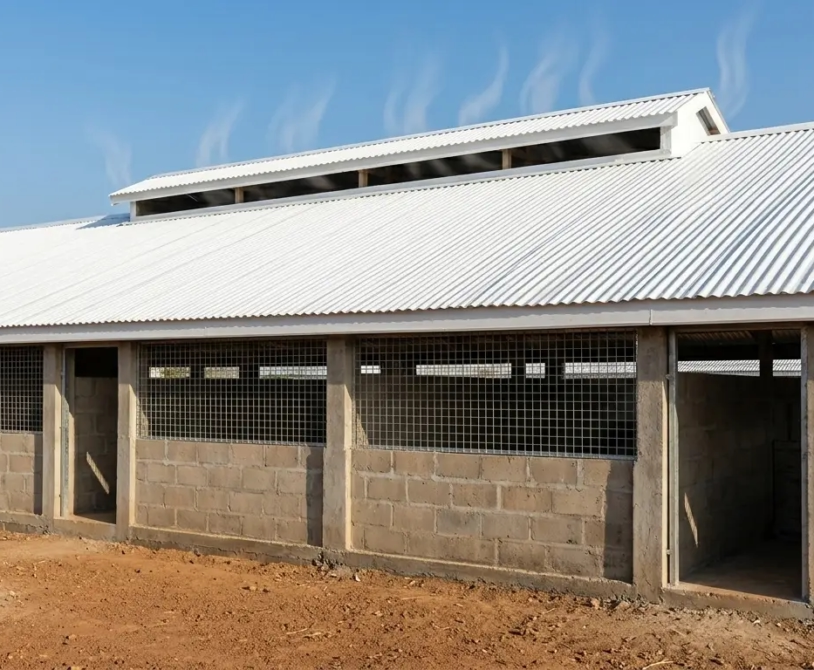
The pen area per pig is the most permanent decision made before production begins. Once concrete is poured and walls are built, the floor space available to each animal is fixed for the next 15–20 years. A pen built too small cannot be economically corrected after construction. Its consequences — reduced growth rate, increased disease pressure, elevated aggression and injury, worsening feed conversion ratio, and below-potential reproductive performance — are paid every day, in every production batch, for the life of the building.
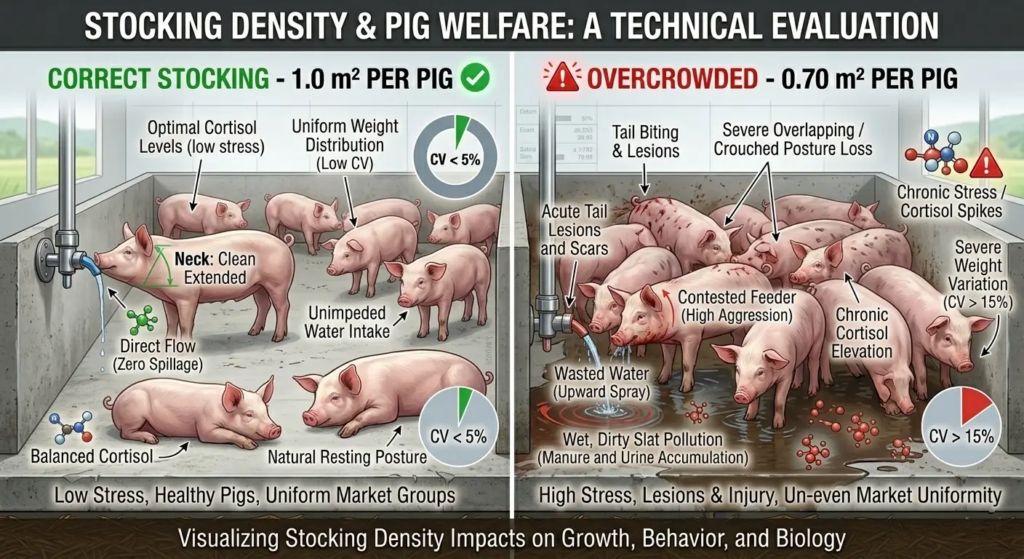
Overcrowding in commercial pig production is among the most commonly underestimated management problems because its effect is distributed rather than acute. A single disease event produces a visible crisis. Chronic overcrowding by 20% produces a 3–5% reduction in daily gain, a 4–7% worsening in FCR, and a persistent elevation in cortisol that suppresses immune function and increases antibiotic usage — none of which announces itself as a building specification problem. The farm manager attributes the performance shortfall to feed quality, genetics, or disease challenge, and the building dimensions are never questioned.
Understanding exactly how much space each pig needs at each production stage — and why — is the prerequisite to building or evaluating housing that supports rather than undermines pig performance.
Why Space Matters: The Science Behind the Specification
The Three Mechanisms of Overcrowding Damage
1. Competitive feed access reduction:
Pigs eat competitively. Dominant animals monopolize feeder space during peak feeding periods, and subordinate animals — typically the smaller, slower-growing individuals already at nutritional risk — are displaced and receive less feed than their requirements. In an overcrowded pen, this competition is intensified: more pigs per feeder means longer queue times, higher displacement frequency, and a wider gap between the daily intake of dominant and subordinate animals.
The production consequence is floor-level data: weight uniformity (the coefficient of variation of body weights across a pen) rises with overcrowding, because subordinate pigs fall further below the group average as dominant animals access more than their share. A pen with high weight variation produces proportionally more lightweight pigs at slaughter — lighter carcasses, more classification penalties, and reduced average revenue per pig.
2. Environmental degradation:
Each pig generates approximately 0.6–1.5 liters of urine and 0.8–1.5 kg of feces per day, depending on age and body weight. At correctly stocked density, the pen’s waste management system — drainage slope, slatted floor, scraping schedule — handles this volume without excessive floor fouling. At densities above specification, the waste volume per unit floor area exceeds the management system’s capacity to process it.
The consequence: wet, fouled floor surfaces that macerate hoof skin, elevate ammonia concentration, increase bacterial pathogen density at floor level, and create the environmental conditions that allow E. coli, Salmonella, and respiratory pathogens to establish at higher prevalence.
3. Chronic stress and immune suppression:
Overcrowded pigs experience measurably elevated cortisol concentrations — the primary stress hormone in swine — compared to correctly stocked pigs in controlled comparisons. Cortisol elevation is not benign. It suppresses lymphocyte proliferation, reduces antibody production in response to vaccination, increases the inflammatory set-point, and diverts metabolic energy from growth and reproduction to stress response management.
A pig whose cortisol is chronically elevated from overcrowding is a pig that requires more feed to achieve the same growth (worsened FCR), responds less effectively to vaccination (reduced disease protection), and expresses more aggression toward pen-mates (more tail-biting events, more wound treatment costs).
Space Allowance by Production Stage: The Complete Specifications
Stage 1: Neonatal Piglets (0–7 kg, Birth to 3–4 weeks)
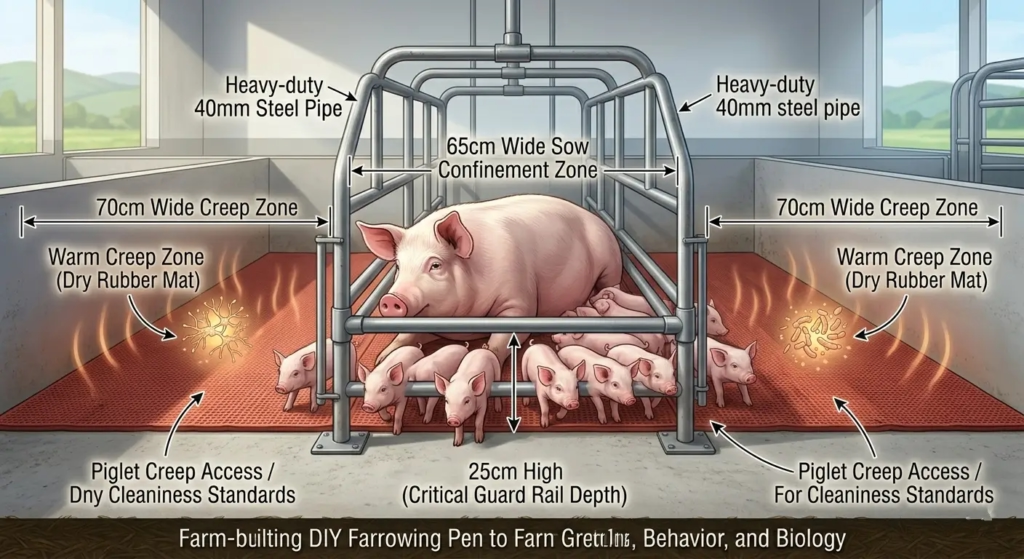
Neonatal piglets are housed with their dam in the farrowing crate. The relevant space specification is the creep area — the designated space within the farrowing pen where piglets can retreat, sleep, and access supplemental feed away from the sow.
Creep area specification:
- Minimum: 0.10 m² per piglet
- Target: 0.12–0.15 m² per piglet
- For a litter of 12 piglets: 1.2–1.8 m² of creep area
Why the creep area matters for survival: The creep is where piglets escape the sow’s crushing risk during lying events. A creep too small forces piglets to remain in the sow zone during her lying sequences — the primary cause of piglet crushing mortality in the first week of life. Farrowing house pre-weaning mortality rates above 12% are frequently associated with inadequate creep dimensions or creep heating that fails to attract piglets away from the sow’s body.
Floor specification for creep: Solid, smooth concrete or rubber mat. Never slatted — neonatal piglet legs fall between slat gaps, causing ligament injuries and a splayed leg condition that produces permanent dysfunction.
Total farrowing pen footprint:
- Sow confinement zone: 0.65 m wide × 2.2 m long = 1.43 m²
- Creep areas (both sides): 2 × 0.65 m × 2.0 m = 2.60 m²
- Total pen: 2.0 m × 2.5 m = 5.0 m² per farrowing unit
Stage 2: Weanlings (7–25 kg, Weeks 3–8)
Weaning is the highest physiological stress event in a pig’s life. The simultaneous loss of maternal immunity, social disruption of pen mixing, feed form change, and housing environment change creates the immunological vulnerability window during which space specification most directly affects disease incidence.
Minimum space allowance:
| Weight Range | Minimum m² per Pig | Notes |
|---|---|---|
| 7–12 kg | 0.20–0.25 m² | First 1–2 weeks post-weaning |
| 12–18 kg | 0.25–0.30 m² | Weeks 2–4 post-weaning |
| 18–25 kg | 0.30–0.35 m² | Final weeks of weanling stage |
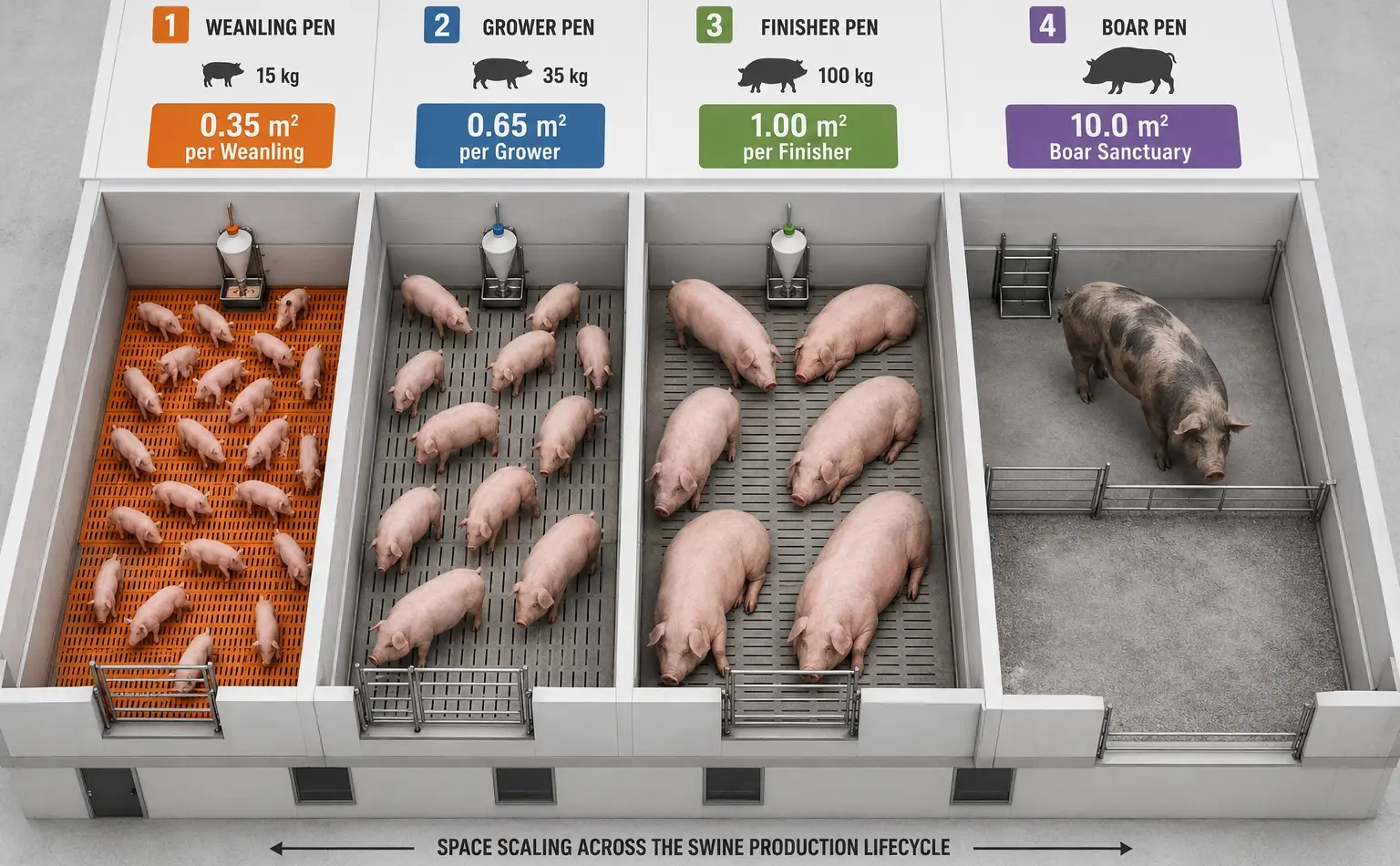
Working specification for pen planning: 0.35 m² per pig at the heaviest weight the pen will hold during the weanling stage. Design for the maximum weight, not the minimum.
Pen calculation for 12 weanlings: 12 pigs × 0.35 m² = 4.2 m² minimum interior pen area Practical dimensions: 2.0 m × 2.2 m = 4.4 m² ✓
Group size for weanlings: 10–15 pigs per pen maximum. Below 10: insufficient social group for behavioral normalization after weaning. Above 15: feeder competition and disease transmission risk increase significantly.
Floor specification: Fully slatted plastic HDPE or polypropylene flooring is the only appropriate floor type for weanling pens. The continuous manure removal through the slats maintains hygienic floor conditions that weanlings — with their immature immune systems — cannot sustain on solid floors with manual cleaning.
The documented cost of weanling overcrowding:
A study comparing 0.25 m² vs. 0.35 m² per pig in weanling pens found:
- 0.25 m² group: 7.2% higher post-weaning mortality, 11% lower average daily gain in weeks 2–4, 18% more antibiotic treatment events per pig
- 0.35 m² group: performance at breed standard targets
At XAF 15,000 (USD 25) per antibiotic treatment course and XAF 90,000 (USD 150) per dead pig: the additional cost of overcrowding by 30% in a 200-pig weanling batch is approximately XAF 1,620,000 (USD 2,700) per batch — significantly exceeding the construction cost of the additional pen space that would have prevented it.
Stage 3: Growers (25–60 kg)
The grower phase is where daily gain and FCR most directly reflect the pen environment. Pigs at 25–60 kg are at the developmental stage of maximum lean tissue accretion rate — they are genetically programmed to deposit lean muscle at their highest lifetime rate during this phase. Environmental stressors that redirect metabolic energy away from lean deposition — cortisol from overcrowding, immune activation from disease challenge, thermal stress from inadequate ventilation — produce the largest proportional growth rate depression during this window.
Minimum space allowance:
| Weight Range | Minimum m² per Pig |
|---|---|
| 25–35 kg | 0.45–0.55 m² |
| 35–50 kg | 0.55–0.65 m² |
| 50–60 kg | 0.65–0.70 m² |
Working specification: 0.65 m² per pig at the heaviest weight in the grower pen.
Pen calculation for 12 growers: 12 pigs × 0.65 m² = 7.8 m² minimum Practical dimensions: 3.0 m × 2.8 m = 8.4 m² ✓
Pen calculation for 10 growers: 10 pigs × 0.65 m² = 6.5 m² minimum Practical dimensions: 3.0 m × 2.2 m = 6.6 m² ✓
Group size for growers: 10–15 pigs per pen. Established pen groups should not be mixed with new pigs after the first 48–72 hours — mixing disrupts the established social hierarchy, triggers aggressive fighting, and produces the cortisol elevation that depresses growth for 5–7 days after mixing.
Floor specification for growers: Partially slatted concrete is the standard — solid lying area at the front of the pen (60% of pen area), slatted dunging area at the rear (40% of pen area). The sloped solid area (2% toward the slats) directs urine and wash water toward the slatted section, maintaining the lying area as a dry, clean surface.
Feeder space: Minimum 7 cm of feeder trough space per pig at the grower stage. Below this, subordinate pigs are displaced from the feeder during the competitive feeding bouts that occur in the first 30 minutes after fresh feed is delivered — reducing their daily intake below requirement and widening group weight variation.
Stage 4: Finishers (60–110 kg)
The finishing phase carries the highest stocking density challenge because each pig’s body weight — and therefore its physical space requirement, metabolic heat output, and daily waste generation — is increasing continuously. A pen correctly stocked at 60 kg will be overcrowded at 100 kg if no animals have been removed.
Minimum space allowance:
| Weight Range | Minimum m² per Pig |
|---|---|
| 60–75 kg | 0.75–0.85 m² |
| 75–90 kg | 0.85–0.95 m² |
| 90–110 kg | 0.95–1.00 m² |
Working specification: 1.00 m² per pig at slaughter weight. Design the pen to the slaughter weight of the heaviest pigs in the batch, not the weight at pen entry.
Pen calculation for 10 finishers: 10 pigs × 1.00 m² = 10.0 m² minimum Practical dimensions: 3.5 m × 3.0 m = 10.5 m² ✓
Pen calculation for 12 finishers: 12 pigs × 1.00 m² = 12.0 m² minimum Practical dimensions: 4.0 m × 3.2 m = 12.8 m² ✓
Group size for finishers: 8–12 pigs per pen. The larger body size of finishing pigs means that at group sizes above 12–15, feeder space competition becomes a constraint even with correct feeder specifications.
The thermal heat load at finisher density:
A 90 kg finishing pig generates approximately 27 watts of metabolic heat. A pen of 12 finishers generates 324 watts of heat continuously — the equivalent of leaving 16 × 20W light bulbs permanently on inside the pen. At incorrect stocking density (15 pigs per pen instead of 12), heat generation increases to 405 watts — 25% more heat that the ventilation system must remove to maintain house temperature within the pig’s thermoneutral zone (16–22°C).
In West African commercial pig houses where ambient temperatures already reach 30–35°C in the dry season, the additional metabolic heat from overcrowding by 25% can raise pen temperature 2–3°C above what the same ventilation system would maintain at correct stocking — pushing pigs above their heat stress threshold and triggering the feed intake reduction, FCR worsening, and growth rate depression that follow.
The ventilation calculation for finisher density:
Required ventilation rate in hot season: 1.5–2.0 m³/hour per kg live weight
For 12 pigs at 85 kg average: 12 × 85 kg × 1.75 m³/hr/kg = 1,785 m³/hour required ventilation through a 10.5 m² pen
For 15 pigs at 85 kg (overcrowded by 25%): 15 × 85 kg × 1.75 m³/hr/kg = 2,231 m³/hour required — 25% more ventilation capacity than the same house design can provide
Stage 5: Gestating Sows (Dry/Pregnant Sows)
The gestating sow’s space requirement is the specification most frequently violated in West African commercial piggeries — because it is the specification that seems least urgent when the focus is on market pig output. The consequence of inadequate gestation space is not visible in today’s pigs; it is visible in the next litter’s performance, and the litter after that, as sow reproductive performance and longevity decline under chronic spatial stress.
Individual gestation stalls:
- Stall width: 60–65 cm
- Stall length: 200–220 cm
- Total area per sow: 1.2–1.4 m² (confined space)
- Advantage: Precise individual feeding without competition
- Welfare consideration: Severely restricts movement; banned in the EU after 4 weeks of gestation; not universally prohibited in West Africa, but increasingly scrutinized by export market buyers
Group gestation pens:
| Group Size | Minimum m² per Sow |
|---|---|
| 2–5 sows | 2.50 m² |
| 6–10 sows | 2.25 m² |
| 11–20 sows | 2.00 m² |
| Above 20 sows | 1.80 m² |
Working specification for small commercial piggeries: 2.25 m² per sow in groups of 5–10.
Pen calculation for 8 gestating sows: 8 sows × 2.25 m² = 18.0 m² minimum Practical dimensions: 4.5 m × 4.0 m = 18.0 m² ✓
Feeding management in group gestation: The primary management challenge of group gestation is preventing dominant sows from consuming subordinate sows’ rations. Solutions:
- Electronic Sow Feeding (ESF) systems: Individual identification of each sow at a single feeding station allows computer-controlled individual ration delivery. Capital cost: XAF 2,000,000–5,000,000 (USD 3,333–8,333) per group of 20–30 sows.
- Simultaneous feeding with individual feeder spaces: One feeder space per sow, minimum 45 cm wide, at the same time, preventing displacement during feeding.
- Floor feeding with visible separation: Not recommended — dominant sows move between feeding spots
Stage 6: Farrowing Sow (Farrowing Crate)
The farrowing crate dimensions determine both the sow’s physiological experience during the most demanding period of her productive cycle and the neonatal piglet’s survival probability in the first critical days of life.
Farrowing crate specification:
| Dimension | Specification | Reason |
|---|---|---|
| Total pen width | 1.8–2.0 m | Accommodates sow zone + two creep areas |
| Total pen depth | 2.4–2.6 m | Accommodates sow length + piglet access |
| Sow confinement zone width | 0.60–0.65 m | Minimum for sow to stand, lie, and turn partially |
| Sow confinement zone length | 2.1–2.3 m | Accommodates sow length at 150–280 kg |
| Creep area width (each side) | 0.60–0.70 m | Space for piglets to feed, sleep, escape |
| Guard rail height above floor | 20–25 cm | Prevents sow crushing piglets against side rails |
| Total farrowing pen area | 4.5–5.2 m² | Per farrowing crate unit |
The crushing prevention architecture: The guard rails (horizontal bars) positioned 20–25 cm above the floor on each side of the sow zone allow piglets to slip beneath them into the creep area when the sow lies down. A sow lying against a crate rail without a bottom guard rail crushes piglets against it directly. This single design element — the bottom guard rail at the correct height — is the primary structural determinant of neonatal piglet crushing mortality.
Stage 7: The Boar Pen
Boars are housed individually and require significantly more space than any other single animal on the farm — not because their body size demands it, but because their psychological and physical health depends on sufficient space for normal locomotive and exploratory behavior.
Boar pen specification:
- Minimum pen area: 7.5 m²
- Recommended: 10–12 m² pen + 15–20 m² exercise run
- Pen dimensions: minimum 2.5 m × 3.0 m (to allow full turning without contact with all walls simultaneously)
- Floor: textured non-slip concrete; rubber mat in resting area
- Sight and smell contact with sows: essential for libido maintenance; pen should allow olfactory and visual access to sow housing without physical contact
Why boar space matters for reproductive performance:
A boar confined in undersized housing (below 7.5 m²) shows measurable:
- Higher cortisol from spatial restriction → reduced testosterone production → lower libido
- Reduced spontaneous locomotion → faster rate of hoof overgrowth and deterioration → lameness
- Increased stereotypic behaviors (bar-biting, repetitive pacing) → welfare indicator of chronic stress
A lame, stressed boar with low libido produces fewer successful natural services per week, lower semen volume per ejaculate, and is more difficult and dangerous to handle during routine management — all consequences of pen dimensions that seemed unimportant during construction.
The Pen Size Calculator: Working Through the Numbers
Formula for Pen Sizing
Step 1: Determine the number of pigs per pen (group size target) Step 2: Determine the production stage and the maximum body weight the pen will hold during that stage Step 3: Apply the minimum m² per pig for that weight range Step 4: Calculate minimum interior pen area: Pigs per pen × m²/pig = minimum m² Step 5: Select practical pen dimensions that exceed the minimum area
Reference table — minimum pen area by stage and group:
| Stage | Max Weight | m²/pig | 8-pig pen | 10-pig pen | 12-pig pen | 15-pig pen |
|---|---|---|---|---|---|---|
| Weanling | 25 kg | 0.35 | 2.8 m² | 3.5 m² | 4.2 m² | 5.25 m² |
| Grower | 60 kg | 0.65 | 5.2 m² | 6.5 m² | 7.8 m² | 9.75 m² |
| Finisher | 110 kg | 1.00 | 8.0 m² | 10.0 m² | 12.0 m² | 15.0 m² |
| Gestating sow | 250 kg | 2.25 | 18.0 m² | 22.5 m² | 27.0 m² | 33.75 m² |
Practical pen dimension examples:
| Minimum Area | Recommended Dimensions | Actual Area | Notes |
|---|---|---|---|
| 3.5 m² (10 weanlings) | 2.0 m × 1.8 m | 3.6 m² | Adequate with slight margin |
| 6.5 m² (10 growers) | 2.5 m × 2.7 m | 6.75 m² | Good working dimensions |
| 10.0 m² (10 finishers) | 3.5 m × 3.0 m | 10.5 m² | Standard commercial finisher pen |
| 18.0 m² (8 gestating sows) | 4.5 m × 4.0 m | 18.0 m² | Minimum group gestation |
The Financial Cost of Underspacing: A Complete Analysis
The Performance Impact of Overcrowding by Stage
| Stage | Overcrowding Level | Daily Gain Reduction | FCR Worsening | Mortality Increase |
|---|---|---|---|---|
| Weanling | 30% above spec | 10–15% | 8–12% | 5–8% points |
| Grower | 25% above spec | 5–8% | 4–7% | 2–4% points |
| Finisher | 20% above spec | 3–5% | 3–5% | 1–2% points |
The Financial Consequence per 100-Pig Batch (Grower to Finisher)
Baseline (correct stocking, 10 pigs per 10 m² pen):
- Target ADG: 800 g/day
- Days 25–100 kg (75 kg gain): 94 days
- FCR: 2.65
- Feed cost: 75 kg × 2.65 × XAF 300/kg = XAF 59,625/pig
- Mortality: 2%
- Revenue per pig at 100 kg: XAF 90,000 (USD 150)
Overcrowded (20% above spec, 12 pigs per 10 m² pen):
- Realized ADG: 752 g/day (−6%)
- Days 25–100 kg: 100 days (+6 days)
- FCR: 2.80 (+5.7%)
- Feed cost: 75 kg × 2.80 × XAF 300/kg = XAF 63,000/pig (+XAF 3,375)
- Mortality: 3.5% (+1.5 percentage points = 1.5 additional dead pigs per 100)
- 6 additional pen-days × overhead cost (XAF 2,500/pig-day): XAF 15,000/pig
Cost per pig of overcrowding:
- Additional feed cost: XAF 3,375 (USD 5.63)
- Additional mortality cost per surviving pig: XAF 1,800 (USD 3.00) allocated
- Additional overhead from extended days: XAF 15,000 (USD 25.00)
- Total overcrowding cost per pig: XAF 20,175 (USD 33.63)
Total overcrowding cost per 100-pig batch: XAF 2,017,500 (USD 3,363)
Construction cost of the additional pen space that would prevent this: Additional area needed: 12 pigs × 1.0 m² − 10.0 m² existing = 2 m² additional. Construction cost at XAF 85,000/m²: XAF 170,000 (USD 283)
The overcrowding decision in financial terms:
Save XAF 170,000 (USD 283) in construction cost. Pay XAF 2,017,500 (USD 3,363) per production batch in performance losses.
At 3 batches per year: XAF 6,052,500 (USD 10,088) annual cost of the construction saving.
Payback period of the additional pen construction: 10 days of production.
Summary
Space allowance is the most permanent and most consequential of all pig housing decisions. The minimum specifications — 0.35 m² per weanling, 0.65 m² per grower, 1.00 m² per finisher, 2.25 m² per gestating sow, 5.0 m² per farrowing unit, 10.0 m² per boar — are not welfare preferences or regulatory requirements that can be negotiated away when construction budgets are tight. They are biological thresholds below which pig performance declines, disease incidence rises, and the financial cost of the space saved exceeds the construction cost of the space not built within one or two production batches.
The correctly stocked pen does not appear to provide an advantage over the overcrowded pen on the day the pigs are placed. The advantage appears in the weekly weight gain record, the feed consumption per kg of gain, the antibiotic usage frequency, the mortality record, and ultimately in the revenue per pen per year that accumulates when pigs perform at genetic potential rather than below it.
Build to specification. The pigs will confirm the decision in every batch they produce.