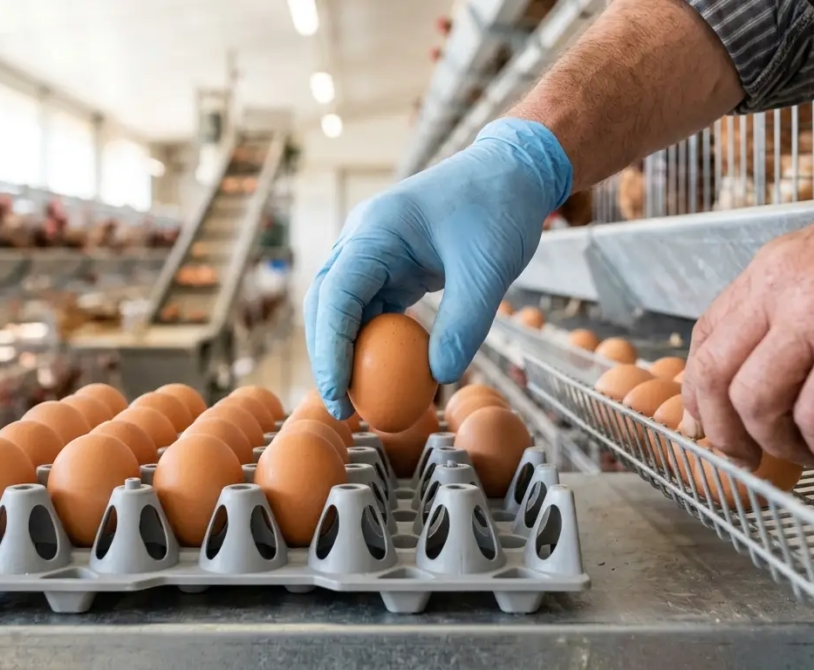

An egg is a biological system in decline from the moment it is laid. The decline is not catastrophic — it is gradual, predictable, and manageable. At the correct storage temperature, it is slow enough that commercial sale windows of 14–21 days are routinely achievable without refrigeration in West African conditions. At incorrect temperatures, the same egg becomes unmarketable in 4–7 days and a food safety risk in fewer.
The difference between those two outcomes is not the egg. It is the temperature at which it has been held from collection to the consumer.
In tropical West Africa, where ambient temperatures during the dry season regularly reach 28–35°C and humidity cycles between 60–90%, egg shelf life is the most temperature-sensitive quality parameter in the commercial layer farmer’s control. A farmer who understands the biology of egg deterioration and the temperature thresholds that govern it has the information to design a storage and handling system that maximizes the commercial window for every egg the flock produces.
This article covers the biology of egg quality decline, the specific temperature thresholds that accelerate and retard it, the storage infrastructure available at different farm scales, the cold chain management requirements for institutional supply, and the practical decisions that extend saleable shelf life in the West African supply context.
The Biology of Egg Deterioration: What Is Actually Happening
The Four Deterioration Processes
Egg quality declines through four simultaneous biological and chemical processes. Understanding each process — and which temperature governs its rate — is the foundation of effective storage management.
Process 1: CO₂ Loss and pH Rise
A freshly laid egg contains approximately 40–70 mg/dL of carbon dioxide (CO₂) dissolved in the albumen. CO₂ loss through the shell pores begins immediately after laying and accelerates with temperature. As CO₂ is lost, the albumen’s pH rises from approximately 7.6 at laying to above 9.3 in a 7-day-old egg held at 25°C.
The practical consequence of rising pH: the thick albumen gel structure denatures. The proteinaceous matrix that makes albumen stand tall and gelatinous (the Haugh unit measure of albumen quality) breaks down as pH rises. An egg that breaks out with a Grade AA albumen on day 1 shows Grade A albumen on day 5 and Grade B albumen on day 10–14 at 25°C storage.
How temperature governs this process: CO₂ loss rate approximately doubles with every 10°C increase in temperature. At 10°C storage, CO₂ is lost at approximately half the rate compared to 20°C, and a quarter of the rate compared to 30°C. This is the primary mechanism by which refrigeration preserves albumen quality — not bacteriostasis but CO₂ retention.
Process 2: Water Loss and Weight Decline
Eggs lose water continuously through shell pores. Water loss produces the air cell — the space between the inner and outer shell membranes at the blunt end of the egg — which grows as water leaves. Fresh eggs have small, barely visible air cells (less than 3mm depth). Week-old eggs have measurably larger air cells. Three-week-old eggs at ambient temperature can have air cells above 8mm that are visible as a visible float when the egg is placed in water.
Water loss rate is governed by both temperature and humidity:
- Higher temperature: increased evaporation rate
- Lower relative humidity: increased evaporation gradient between egg interior (near 100% RH) and surrounding air
- Shell damage (cracked cuticle, washed shell): increased permeability accelerates water loss
The practical consequence for storage in tropical West Africa: The combination of high temperature and often-variable humidity creates a water loss environment that is significantly more aggressive than the temperate conditions assumed in most published egg shelf life data. An egg stored at 30°C and 60% relative humidity loses water approximately 3–4× faster than the same egg stored at 10°C and 85% relative humidity.
Process 3: Bacterial Penetration and Growth
A freshly laid egg has multiple antimicrobial defense layers: the cuticle on the exterior, the shell itself, the inner and outer shell membranes, and specific antimicrobial proteins in the albumen (lysozyme, ovotransferrin, avidin). Despite these defenses, bacteria on the shell surface can penetrate to the albumen over time — particularly when the cuticle is damaged, the egg is contaminated at collection, or temperature fluctuations create the suction effect that draws bacteria through pores.
Once bacteria enter the albumen, the rate of proliferation is governed by temperature:
- At 10°C, most poultry pathogens grow very slowly; Salmonella generation time exceeds 24 hours
- At 20°C: bacterial growth accelerates significantly; Salmonella generation time approximately 4–6 hours
- At 30°C: rapid proliferation; Salmonella generation time 1–2 hours; contamination can reach hazardous levels within 24–48 hours
- At 37°C: near-optimal growth temperature for most poultry pathogens; contamination can reach dangerous levels within hours
Process 4: Lipid Oxidation in the Yolk
Egg yolk lipids — particularly the polyunsaturated fatty acids that make eggs nutritionally valuable — oxidize over time, producing off-flavors and reducing nutritional value. Oxidation rate is governed by temperature and by the presence of pro-oxidants (free iron, light exposure). Rancid egg flavor — the “old egg” smell that consumers recognize — is primarily the product of lipid oxidation in the yolk at ambient or elevated storage temperatures.
Temperature Thresholds: The Numbers That Define Commercial Decisions
The Critical Temperature Ranges
Below 10°C (Commercial Cold Storage):
- CO₂ loss: Very slow; albumen quality maintained for 6–8 weeks
- Water loss: Minimal; weight loss below 0.5% per week
- Bacterial growth: Suppressed; Salmonella and E. coli multiplication essentially halted
- Lipid oxidation: Very slow; yolk quality maintained
- Commercial consequence: Maximum shelf life; mandatory for washed eggs; appropriate for export and long-distance supply chains
10–15°C (Cool Room / Intermediate Storage):
- CO₂ loss: Slow; albumen Grade A maintained for 3–4 weeks
- Water loss: Low; commercial weight loss within acceptable limits for 4–5 weeks
- Bacterial growth: Significantly retarded
- Commercial consequence: Appropriate for institutional supply with 1–2 week delivery cycle; achievable with low-energy cool room or shade + evaporative cooling
15–20°C (Controlled Ambient — Shade, Ventilation):
- CO₂ loss: Moderate; albumen quality declines to Grade B by week 3
- Water loss: Moderate; air cell visible by week 2
- Bacterial growth: Retarded but not suppressed; risk increases after 7–10 days for contaminated eggs
- Commercial consequence: Acceptable for supply chains with weekly turnover; the target range for farms without refrigeration
20–28°C (Typical Indoor Ambient — West Africa):
- CO₂ loss: Significant; albumen quality declines from Grade AA to Grade B within 7–10 days
- Water loss: Significant; air cell clearly visible by day 7–10
- Bacterial growth: Active; contaminated eggs pose a safety risk after 5–7 days
- Commercial consequence: Safe commercial window: 7–10 days for clean eggs; 3–5 days for washed eggs; suitable only for high-turnover direct retail
28–35°C (Tropical Uncontrolled Ambient — Peak Dry Season):
- CO₂ loss: Rapid; Grade A to Grade B transition within 4–5 days
- Water loss: High; significant air cell within 5–7 days
- Bacterial growth: Rapid proliferation; food safety risk for contaminated eggs within 24–48 hours
- Commercial consequence: Not suitable for storage; sell within 24–48 hours of collection, or invest in temperature control immediately
The Shelf Life Prediction Table
| Storage TemperatureIntact Cuticle Clean EggDry-Cleaned EggWashed Egg (No Refrigeration) | |||
|---|---|---|---|
| 8–10°C | 60–90 days | 45–60 days | 14–21 days |
| 12–15°C | 35–50 days | 25–35 days | 10–14 days |
| 18–22°C | 21–28 days | 14–20 days | 5–8 days |
| 25–28°C | 10–14 days | 7–10 days | 3–5 days |
| 30–35°C | 5–7 days | 3–5 days | 1–2 days |
This table demonstrates the compounding importance of two decisions: temperature management and whether the egg was washed. A clean, unwashed egg stored at 12–15°C has 35–50 days of commercial life. The same egg washed and stored without refrigeration at 30–35°C is a food safety risk within 24–48 hours. The combination of washing (removes cuticle) and elevated temperature (accelerates all deterioration processes) is the most damaging storage scenario available in tropical West Africa.
Practical Storage Infrastructure: What Is Available at Each Scale
Stage 1: No Dedicated Storage (Up to 300 Birds, Daily Sale)
At a very small commercial scale, where all production is sold daily through direct retail or local wholesale, storage infrastructure is not a primary concern. The priority is collection-to-sale speed: collect, grade, tray, deliver. An egg sold within 24 hours of collection at any ambient temperature is fresh and safe.
Management requirements:
- Collect a minimum of 3 times per day to minimize the time eggs spend at house temperature (30–35°C)
- Shade the collection area — a thatched roof or corrugated iron canopy positioned to keep the collection staging area below 30°C
- Complete all sales before 14:00 on collection day — ambient temperature continues rising through the afternoon; eggs staged for sale in the late afternoon have spent the hottest hours at uncontrolled temperature
Stage 2: Simple Cool Storage (300–1,000 Birds, 2–3 Day Supply Cycle)
At this scale, the farm needs 2–3 days of saleable inventory on hand to accommodate delivery schedules to multiple buyers. The storage environment must reliably hold temperatures below 25°C to maintain Grade A quality for the commercial window.
Option A — Evaporative Cool Room (Lowest Cost)
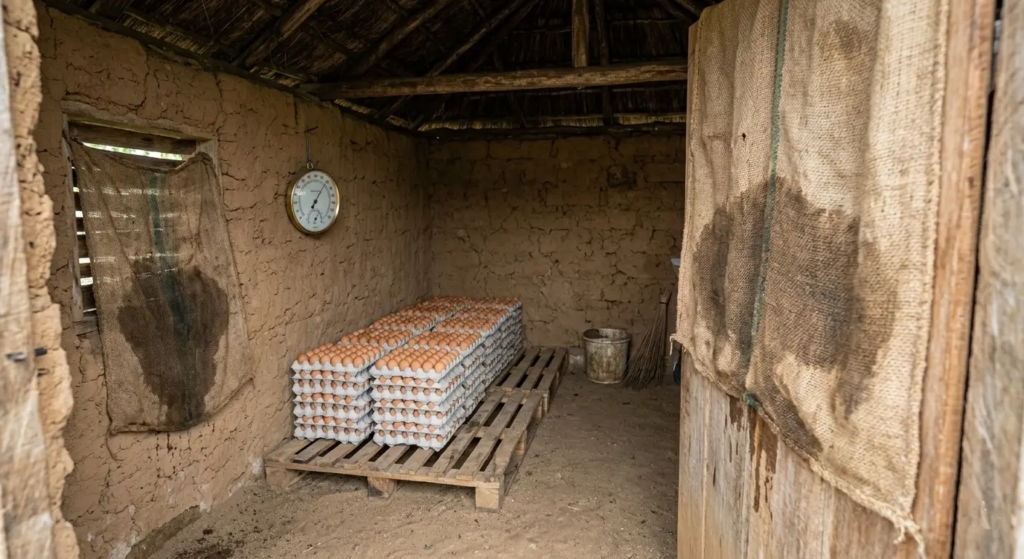
A sealed room with evaporative cooling — wet burlap sacks suspended in the doorway, wet sand floor, and adequate ventilation to allow evaporation — can hold temperatures 5–8°C below ambient in a humid climate. In Douala’s coastal conditions, where ambient humidity is already 80–90%, evaporative cooling efficiency is lower — only 2–4°C below ambient. In drier highland areas (Bafoussam, Bamenda), evaporative cooling is more effective, 6–10°C below ambient.
Construction: A small room (2m × 3m) built with thick mud-brick walls (thermal mass), a wet sand floor, and a ventilation opening fitted with wet burlap sacking on the windward side and an exit opening on the leeward side. Total construction cost: XAF 200,000–450,000 (USD 333–750). Operating cost: near zero (water to wet burlap daily).
Achievable temperature: 20–25°C in lowland coastal areas; 18–22°C in highland areas.
Option B — Shaded, Ventilated Storage Room
A storage room positioned on the shaded north-facing side of the main building, constructed with thick walls (brick or block), a high ceiling, and louvered vents that allow natural airflow without direct sun exposure. In equatorial West Africa, where the sun passes nearly overhead, the north-facing aspect provides the most consistent shade. Ceiling fans improve airflow and temperature distribution.
Achievable temperature: 22–28°C in lowland areas during harmattan; 20–24°C in highland areas year-round.
Commercial shelf life in this environment: 7–14 days for clean unwashed eggs — adequate for a weekly delivery cycle to institutional buyers.
Stage 3: Mechanical Refrigeration (1,000–5,000 Birds, Institutional Supply)
At this scale, mechanical refrigeration is the appropriate investment — particularly for farms supplying hotels and supermarkets that specify freshness guarantees and maximum-age-at-delivery standards.
Single-room cold storage unit (walk-in):
- Capacity: 500–2,000 egg trays, depending on shelving configuration
- Temperature: 8–15°C (adjustable)
- Humidity control: Some units include humidity control; target 75–85% RH to balance bacterial suppression with minimal moisture loss from eggs
- Capital cost: XAF 1,500,000–5,000,000 (USD 2,500–8,333) for a commercial cold room appropriate for this scale
- Operating cost: XAF 30,000–80,000 (USD 50–133) per month in electricity
Chest freezer (secondary option for smaller farms):
- Running at 10–15°C (set to refrigerator mode, not freezer) — a large chest freezer can hold 300–500 trays
- Less efficient in energy terms than a purpose-built cold room
- Capital cost: XAF 250,000–600,000 (USD 417–1,000) for a large domestic chest freezer
- Limitation: temperature uniformity is poor; eggs at the bottom are colder than eggs near the top
Energy cost management:
- Connect the cold room to a solar-with-battery system (3–5 kW solar + 200–400 Ah battery storage)
- The cold room thermal mass — once chilled to the target temperature — maintains temperature for 4–6 hours after power interruption in a well-insulated room
- Cost of solar system appropriate for cold room: XAF 1,500,000–4,000,000 (USD 2,500–6,667) — recovers in reduced electricity costs over 3–5 years at current grid electricity prices
Stage 4: Commercial Cold Chain (5,000+ Birds, Export or Urban Premium Supply)
At a large commercial scale, the cold chain extends from the farm’s refrigerated storage through refrigerated delivery vehicles to the buyer’s cold storage. Eggs entering the cold chain at 10°C must remain at or below 15°C through every stage — because temperature fluctuations above the storage temperature create condensation on shells (sweating) that accelerates bacterial penetration.
Refrigerated delivery vehicle:
- For a 5,000-bird farm delivering to 10–15 institutional buyers: a small refrigerated van (2–3 tonne capacity, refrigeration unit maintaining 10–15°C)
- Capital cost: XAF 8,000,000–20,000,000 (USD 13,333–33,333) for a vehicle appropriate for this scale
- Alternative: contract with a refrigerated logistics provider who already operates cold chain delivery routes in the target city
The full cold chain requirement: The institutional buyers (hotels and supermarkets with food safety audits) who pay premium prices for fresh eggs increasingly require documented cold chain maintenance — temperature logs from the farm’s cold room, delivery vehicle temperature records at loading and delivery, and maximum-age-at-delivery guarantee (typically 7–10 days from collection date for premium institutional channels). A farm that cannot provide this documentation will eventually be replaced by one that can, as food safety standards formalize in West African institutional purchasing.

Egg Freshness Testing: Field Methods
In the absence of laboratory equipment, three field methods allow freshness assessment at the farm or point of delivery:
The Float Test
Place the egg in a bowl of clean water at approximately 20°C:
| Egg Behavior | Interpretation | Approximate Age (at 25°C) |
|---|---|---|
| Sinks flat, lies on side | Very fresh | 0–5 days |
| Sinks but tilts at angle | Fresh | 5–10 days |
| Stands on end, touches bottom | Older but still acceptable | 10–15 days |
| Floats at surface | Stale or spoiled — do not sell | Above 15–20 days (temperature-dependent) |
Limitation: The float test is governed by air cell size, which is influenced by storage temperature and humidity. An egg stored at 30°C for 7 days may fail the float test, while an egg of the same production date stored at 15°C might remain at the “fresh” position. The test indicates relative freshness for the storage conditions that the egg experienced — it cannot produce an absolute age measurement.
The Candling Test
Hold the egg against a bright light source (bright flashlight or commercial candling lamp) in a darkened room:
- Fresh egg: Small, distinct air cell at the blunt end; yolk shadow visible as a faint, centered oval; albumen appears clear
- Older egg: Air cell enlarged and mobile (moves when egg is rotated); yolk shadow more visible and off-center as albumen loses viscosity; possible dark spots indicating bacterial growth
- Spoiled egg: Large, freely mobile air cell; clearly visible yolk; possible black or dark shadow areas indicating microbial degradation
Candling is the commercial standard for interior quality assessment without breaking the egg. For institutional supply, a weekly 30-egg candling sample from each storage batch verifies that storage conditions are maintaining quality within the commercial window.
The Break-Out Test
Crack the egg onto a clean flat plate:
- Grade AA: Albumen stands high, gelatinous, not spread beyond 7–8 cm from the center; yolk stands rounded and tall
- Grade A: Albumen spreads to 10–12 cm; yolk rounded but slightly flattened
- Grade B: Albumen thin and watery, spreads beyond 12 cm; yolk flat
Conduct on 10 eggs per storage batch weekly. If more than 20% of sampled eggs show Grade B albumen quality before the expected sell-by date, the storage temperature is too high, and the storage system requires review.
The Condensation Problem: Cold Eggs in Hot Markets
The most common shelf life failure in West African institutional egg supply occurs not in storage but at the point of transition from cold storage to ambient market conditions — condensation.
When a cold egg (stored at 10°C) is moved directly into a warm, humid market environment (28°C, 80% RH), water immediately condenses on the shell surface. This condensation:
- Creates a liquid film on the shell surface through which bacteria from the market environment penetrate shell pores rapidly
- Appears to consumers as evidence that the eggs are “sweating” — a negative quality signal in many markets
- Accelerates bacterial penetration at exactly the moment the egg is most exposed to environmental bacterial load
The protocol for transitioning cold eggs to ambient market conditions:
Do not move cold eggs directly into a warm market environment. Allow them to equilibrate gradually:
- Remove eggs from cold storage to a shaded, relatively cool staging area (20–24°C) 1–2 hours before delivery or display
- Allow condensation to form and evaporate naturally in the cooler staging area before exposure to full market temperature and humidity
- If delivering to a buyer with refrigerated storage: maintain cold chain continuously — deliver cold, buyer stores cold
For farms supplying open-air markets where ambient temperature is 28–35°C and refrigerated storage at the market end is not available: consider whether washed + refrigerated eggs are the appropriate product for this channel. Unwashed, intact-cuticle eggs at ambient temperature are often more appropriate and safer for non-refrigerated market channels — not because they are superior in a cold chain, but because they were designed to survive without one.
Practical Storage Recommendations by Market Channel
| Market Channel | Recommended Storage | Maximum Age at Sale | Notes |
|---|---|---|---|
| Open-air market (daily turnover) | Shaded ambient (below 28°C) | 7 days | Clean, unwashed eggs only |
| Local wholesale (weekly delivery) | Cool room or shaded storage (20–25°C) | 10 days | Grade A minimum; dated trays |
| Restaurant/catering supply | Cool room (15–20°C) or refrigerated | 14 days | Deliver twice weekly; dated trays |
| Hotel institutional supply | Refrigerated (8–12°C) | 10 days from collection | Cold chain maintained; temperature log |
| Supermarket shelf | Refrigerated display (8–12°C) | 21 days from packing date | Full cold chain; use-by date on tray |
| Export | Refrigerated cold chain (8°C) | 28 days from packing | Continuous cold chain; food safety documentation |
Summary
Egg shelf life in West Africa is not fixed. It is determined by temperature from the moment the egg leaves the nest box, and every degree above the optimal storage range accelerates the biological decline processes that reduce quality, extend bacterial risk, and shrink the commercial window.
The practical framework is straightforward: understand the temperature thresholds, match the storage infrastructure to the production scale and market channel requirements, never wash eggs destined for ambient supply chains, manage the condensation risk when cold eggs meet warm environments, and document the storage conditions for institutional buyers who increasingly require that documentation as a condition of purchase.
An egg that has been held at the correct temperature from the nest box to the consumer is the freshest egg that the bird could produce on that day. An egg that has been held at 32°C in an enclosed hot storage room for five days before sale is a different product from the same hen. Temperature is not a storage preference. It is the biological clock that every egg is running on.
Control the clock. Extend the sale window. Protect the revenue.