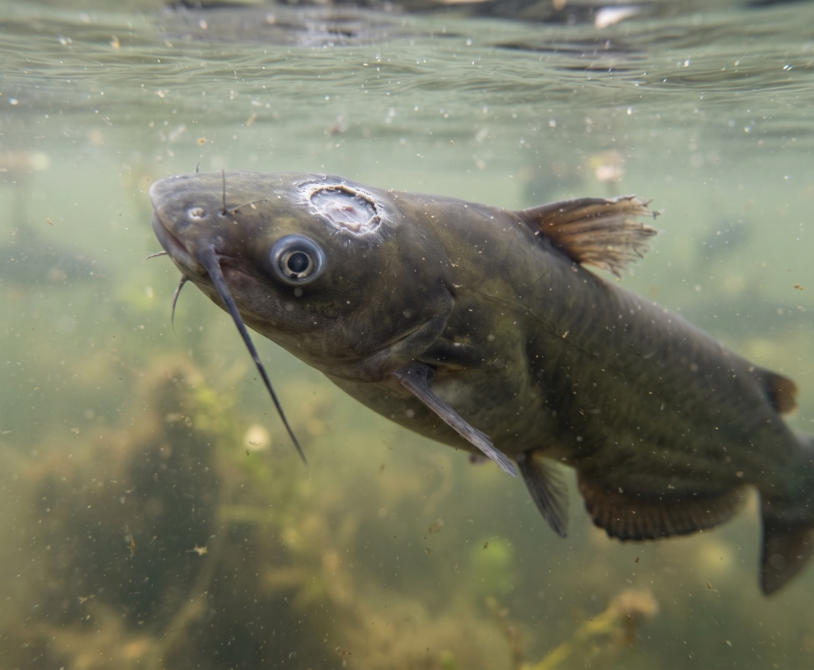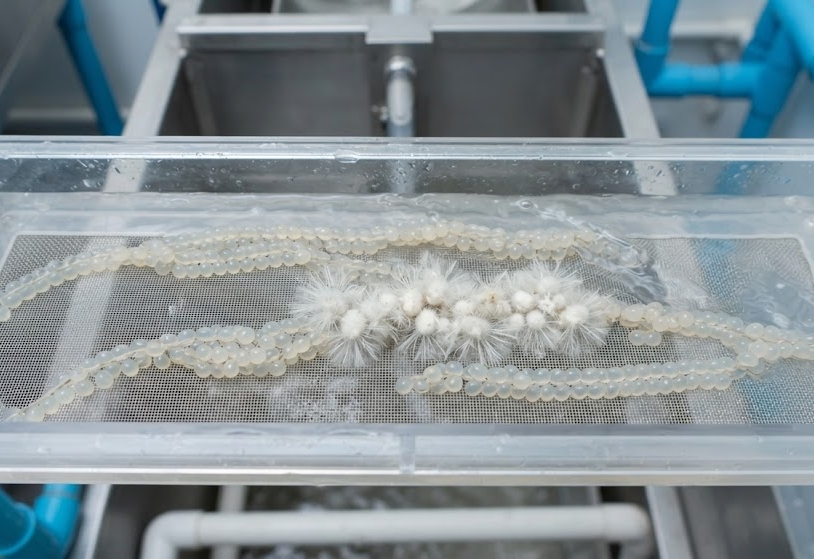
The disease management articles preceding this one in the series describe what to do after a pathogen has established itself in the production population. This article addresses what to do before — the biosecurity framework, quarantine protocols, and wildlife exclusion measures that determine whether pathogens enter the production system in the first place.
The financial logic of prevention over treatment in commercial catfish farming is straightforward: treating an active Aeromonas outbreak costs XAF 300,000–800,000 in antibiotic and treatment supplies, produces 2–4 weeks of suppressed production from reduced feed intake, and results in 5–15% mortality in the affected tank. A biosecurity protocol that prevents the introduction costs a fraction of this — primarily in management discipline and relatively modest infrastructure. The prevention investment is not dramatic. The treatment cost is.
What makes biosecurity intellectually straightforward but operationally challenging is that its benefit is invisible when it works. The pathogen that never entered the farm, the fingerlings that never introduced Ich to the production system, the heron that never ate fish and deposited Aeromonas-contaminated feces into the pond — none of these prevention successes generate an observable event. The only observable event in a biosecurity success is the absence of the disease that was prevented, which is not the kind of evidence that motivates continued investment in prevention systems.
This guide makes the prevention logic visible — by mapping the specific pathways through which pathogens enter commercial catfish farms, and specifying the practical measures that close each pathway, the case for biosecurity investment becomes as quantifiable as the treatment cost it prevents.
Pathogen Entry Pathways in Commercial Catfish Production
Mapping the Routes of Introduction
Every disease event in a commercial catfish farm has an entry pathway — a specific route through which the causative pathogen crossed the boundary from the external environment into the production system. Biosecurity design is the systematic closure of these pathways. Understanding them specifically, rather than implementing vague “good hygiene” practices, allows targeted, cost-effective prevention.
Pathway 1: New fish introduction (highest risk)
Fingerlings, broodstock, and replacement fish sourced from external hatcheries or other farms carry the pathogens of their source population — bacterial agents, protozoan parasites, monogenean flukes, and potentially viral pathogens that may not be clinically evident in the source population but will express disease in a naive recipient population.
This is the single most common documented route of new pathogen introduction to previously clean production systems. It is also the most completely preventable — quarantine and prophylactic treatment of all incoming fish before contact with the production population intercepts pathogens at the entry point before they have access to the production animals.
Pathway 2: Water source contamination
Water supplied from rivers, streams, and surface reservoirs carries the pathogens present upstream in that watercourse — from wild fish populations (which harbor many of the same protozoan and bacterial pathogens as farmed fish), from upstream discharge (other farms, human communities), and from wildlife contact with the water source. Ichthyophthirius theronts, Trichodina, Columnaris bacteria, and various enteric pathogens can all be introduced through contaminated water sources.
Borehole water is substantially lower risk than surface water for most fish pathogens — most fish-specific pathogens do not survive in groundwater without a fish host. However, borehole water can carry environmental bacteria (Aeromonas, Pseudomonas) at levels that become relevant in combination with immunosuppressed fish.
Pathway 3: Equipment and fomite transmission
Nets, buckets, grading equipment, measuring tools, aerator attachments, and any object moved between tanks or between farms without disinfection carries the pathogen load from the source tank or farm to the destination. A net used to move fish from an Ich-infested tank to a clean tank introduces Ich theronts that can infest the clean tank within hours.
Pathway 4: Personnel
Farm workers who handle fish in multiple tanks without hand washing and equipment disinfection mechanically transport pathogens on their hands, arms, and clothing. This pathway is most significant for protozoan parasites (Trichodina and Ich theronts can be transported on wet hands between tanks during close-interval management activities and for bacterial pathogens that survive on wet surfaces.
Pathway 5: Wildlife (birds, reptiles, amphibians)
Herons, kingfishers, egrets, cormorants, and other piscivorous birds visit catfish ponds and tanks — eating fish directly and contaminating the water with feces that may carry fish pathogens from previously visited farms or wild water bodies. Frogs and toads introduce Saprolegnia and enteric bacteria through their feces. Reptiles (monitor lizards, crocodilians in some locations) are both direct predators and pathogen vectors.
Pathway 6: Feed and organic inputs
Improperly stored feed with mold growth introduces fungal spores. Wild-caught fish or invertebrates used as supplemental feed introduce the parasites and pathogens of those prey animals. Pond fertilizers of animal origin (poultry manure, pig slurry) introduce enteric bacteria into pond water.
The Biosecurity Framework for Catfish Farms
Zone-Based Design Principles
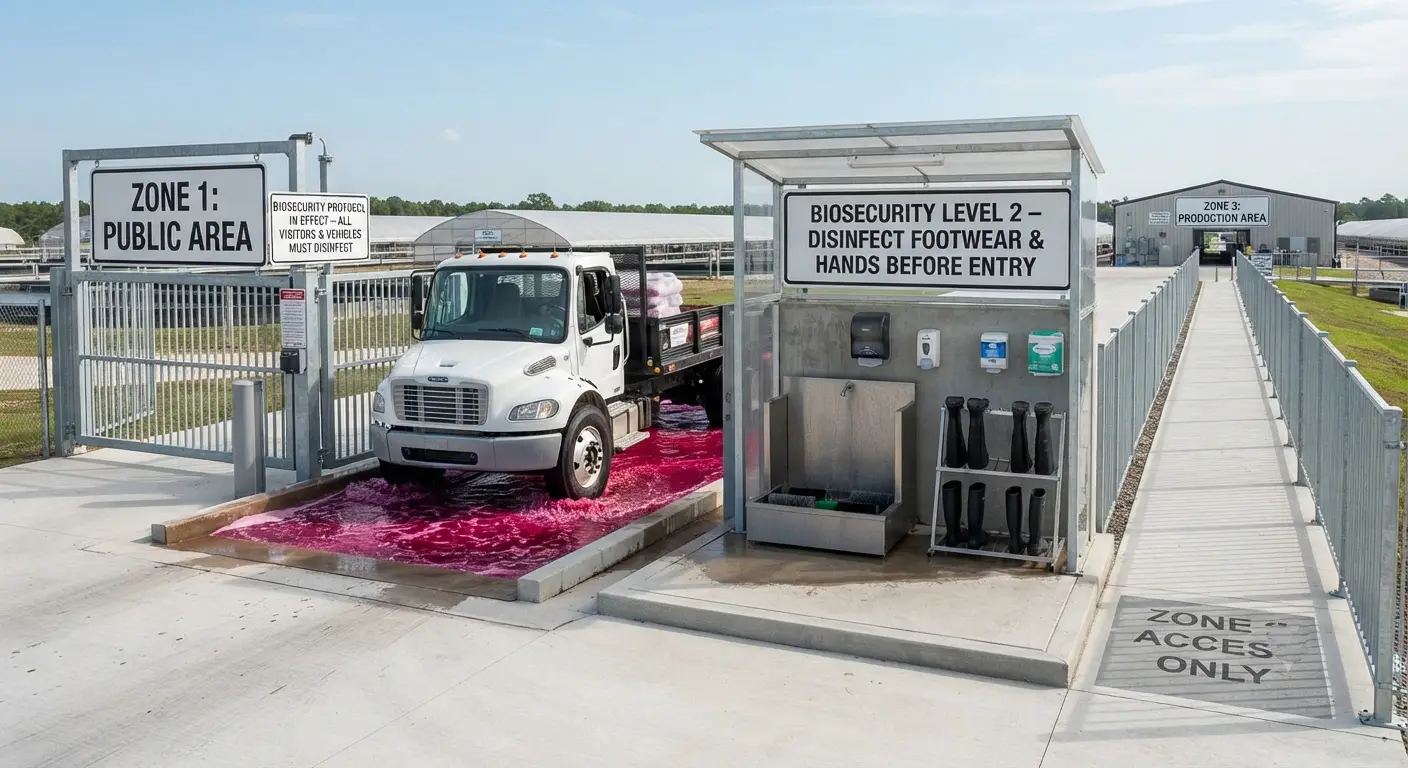
The same zone-based biosecurity architecture described in the pig series biosecurity framework article applies directly to commercial catfish farming — with modifications appropriate to the aquatic production context:
Zone 1 (External/Public): Everything outside the farm perimeter. No pathogen control — pathogens from wild fish, wildlife, neighboring farms, and the general environment circulate freely.
Zone 2 (Farm Service Zone): Inside the perimeter fence, outside the production tanks and ponds. Contains feed storage, staff facilities, equipment storage, vehicle parking, and visitor reception.
Zone 3 (Production Zone): All production tanks, ponds, and their immediate surrounding areas. Access restricted to authorized personnel following transition protocols.
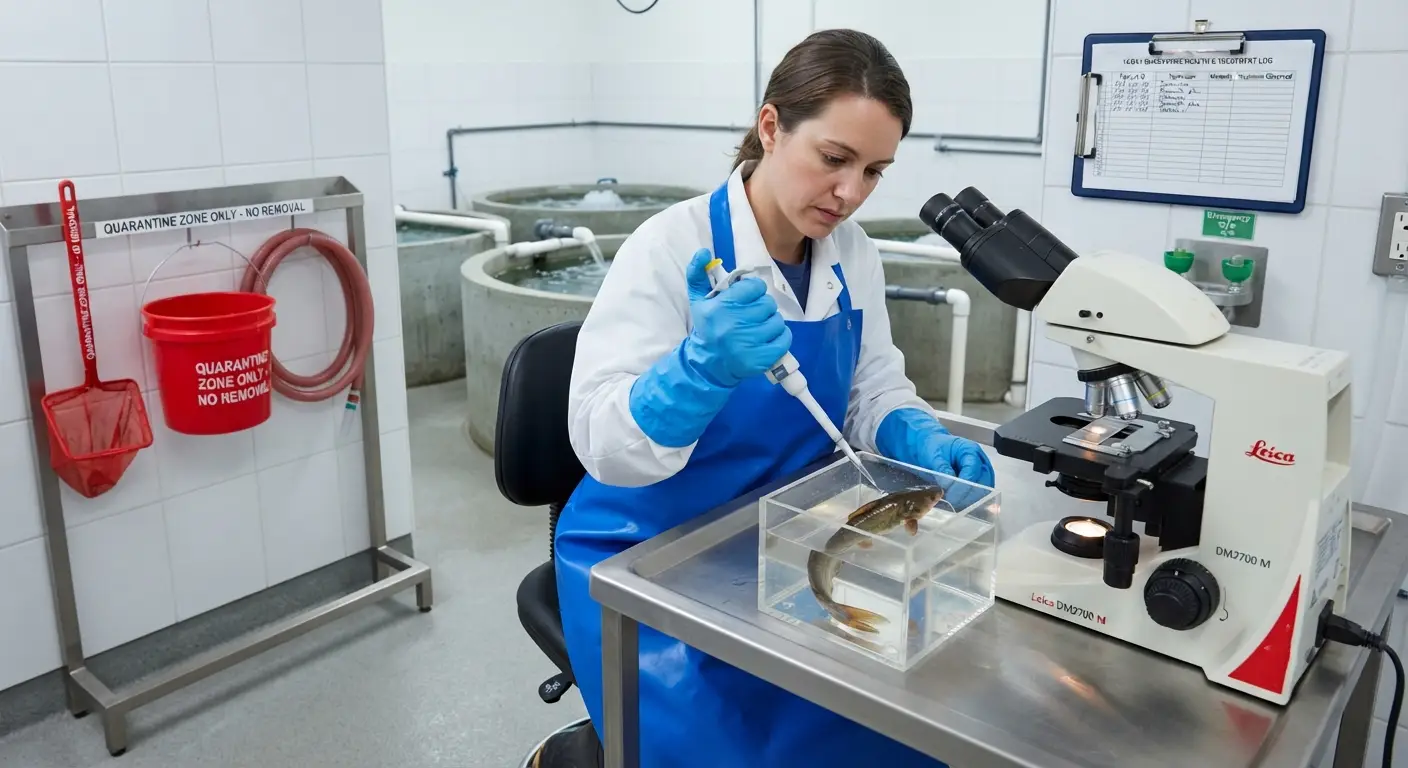
Zone 4 (Quarantine Zone): Physically separated from Zone 3, within Zone 2 or at the Zone 2 perimeter. Houses incoming fish before clearance to Zone 3, and sick fish isolated from the production population.
Entry Control for Personnel
Staff daily protocol:
- Dedicated farm footwear and clothing that remains on the farm — personal clothing and footwear from outside the farm carry mud, organic material, and associated pathogens
- Hand washing before handling fish or equipment in any production tank — particularly critical when moving between tanks
- Dedicated tank-specific equipment where feasible for high-value production tanks (hatchery, broodstock, fingerling) — each tank has its own net, bucket, and tools that are not shared with other tanks
Visitor protocol:
- Register all visitors (name, purpose, recent farm visits)
- Provide visitors with dedicated farm footwear (rubber boots) before entering Zone 3 — visitors’ personal footwear carries contamination from wherever they came from
- Accompany visitors throughout Zone 3 — unaccompanied visitors may inadvertently (or deliberately) move equipment between tanks or introduce contamination in ways that supervised visits prevent
Entry Control for Equipment
The between-tank disinfection rule:
Any piece of equipment that contacts tank water — nets, buckets, grading equipment, siphon tubes, aerator stones, sampling containers — must be disinfected before moving from one production tank to another. This single protocol, consistently applied, prevents the most common within-farm pathogen spread mechanism.
Practical between-tank disinfection protocol:
- Rinse equipment in clean water to remove gross organic material (mucus, feces, feed residue)
- Immerse in a disinfectant solution for 2–5 minutes — appropriate options:
- 200 mg/L sodium hypochlorite (bleach diluted to this concentration from commercial 5% bleach solution): 40 mL bleach per liter of water
- Potassium permanganate at 500 mg/L
- Quaternary ammonium compound at manufacturer-specified concentration for aquaculture use
- Rinse thoroughly with clean water before use in the next tank — residual disinfectant in equipment entering a fish tank causes chemical burns or toxicity at the concentration applied in the disinfection step
Equipment color-coding: Where equipment is dedicated to specific zones or tank categories (hatchery vs. grow-out vs. quarantine), color-coding (different colored nets, buckets, and handles for each zone) provides a visual management signal that reduces accidental cross-contamination from equipment used in the wrong zone.
Water Treatment at Intake
For farms using surface water sources where pathogen load is a concern:
UV sterilization of supply water: UV sterilizers on the incoming water supply line irradiate the water at a dose sufficient to inactivate most fish pathogens (minimum 30 mJ/cm² for most bacteria and protozoa; 40–60 mJ/cm² for viruses). Select a UV unit rated for the farm’s maximum daily water flow rate.
Sand filtration: A sand filter on the incoming water supply physically removes suspended solids, including protozoan cysts and bacteria, from the water — less complete pathogen removal than UV but removes the suspended organic particles that carry and protect pathogens.
The farm with a borehole source: Borehole water can generally be used without sterilization for most pathogen risks. The primary water treatment concern for borehole sources is iron removal (as covered in the site selection article) rather than pathogen inactivation.
Quarantine Protocols for New Fish
The Quarantine Facility
The quarantine facility for catfish farms requires the same physical characteristics described for pig farm quarantine in the pig series biosecurity guidance — genuine physical separation from the production population, dedicated water supply and drainage, dedicated equipment, and last-in-daily-routine management sequencing:
Physical requirements:
- Minimum 30–50 meters from production tanks/ponds — not simply an empty section of the same building, but a genuinely separate structure with separate airspace (relevant for aerosol-transmissible pathogens) and separate drainage that does not connect to the production water system
- Separate water supply connection or dedicated header tank — incoming fish should not receive water that has passed through production tank infrastructure
- Concrete tanks (for observation, treatment, and cleaning accessibility) in preference to earthen quarantine ponds — the ability to completely drain, clean, and disinfect the quarantine facility between occupancies is essential for its function
Equipment dedication: Every item used in the quarantine facility — nets, buckets, aerators, feeding equipment, treatment containers, measurement tools — stays in the quarantine facility. Nothing moves from quarantine to production without complete disinfection.
Staff sequencing: Quarantine facility work is the last task in the daily routine — after all production tank and pond management is complete. The same logic applies in the pig series: a staff member who has handled potentially infected fish in quarantine should not subsequently handle production fish in the same work session without showering and changing clothing.
The 14–21 Day Quarantine Protocol
All incoming fish — fingerlings from external hatcheries, replacement broodstock, any fish from outside the farm’s production system — undergo a minimum 14 days of quarantine before contact with the production population:
Day 1–3 (arrival and assessment):
- Receive fish into the quarantine facility and complete the acclimatization protocol described in the fingerling sourcing article
- Record: source, quantity, size, transport duration, visible condition at arrival
- Observe for 24 hours without treatment — assess behavior, feeding response, and any external signs
- Collect 5–10 fish for wet mount microscopy: gill and skin examination for Trichodina, Gyrodactylus, Dactylogyrus, and any other external parasites
Day 3–7 (prophylactic treatment):
Based on microscopy findings and source knowledge, initiate prophylactic treatment:
External parasites present on microscopy: Treat with appropriate agent (salt, formalin, or praziquantel as per the parasite treatment protocols in the previous article) on Day 3 and verify clearance by repeat microscopy on Day 6–7.
External parasites absent on microscopy, but source is high-risk: Still administer prophylactic salt treatment (3–5 g/L for 24–48 hours) — this is the quarantine’s primary pathogen reduction measure even when individual examination appears clean, because not all fish in a batch will carry the infestation and a sample examination may miss it.
Internal parasites (from known high-risk wild or pond sources): Administer levamisole in medicated feed (50–100 mg/kg body weight per day for 3 days) during the quarantine period to eliminate intestinal nematodes before introduction to the production system.
Day 7–14 (observation and monitoring):
- Daily observation of behavior, feeding response, and any clinical signs
- Repeat wet mount microscopy on Day 10–12 to verify parasite clearance
- Monitor water quality daily — declining DO or rising ammonia in the quarantine tank without explanation may indicate disease-related mortality or metabolic change in the fish
Day 14–21 (clearance assessment):
- Clinical observation confirms no active disease signs
- Microscopy confirms parasite clearance
- All prophylactic treatment withdrawal periods have elapsed
- Decision to release fish to production zone OR extend quarantine if any concern remains
The clearance decision must be conservative: A single suspicious fish, an unresolved clinical sign, or an unexplained mortality above 1% cumulative during quarantine should extend the quarantine period rather than trigger early release. The cost of an additional week in quarantine is always less than the cost of introducing a pathogen to the production population.
Predator Control
The Double Cost of Predators
Wildlife predators of catfish farms impose two distinct and cumulative costs — the direct loss of fish that are eaten, and the indirect cost of the disease pathogens that predators introduce through their feces and saliva into the production water.
A heron that consumes 500 g of catfish per visit to an earthen pond has caused XAF 1,250 in direct production loss at XAF 2,500/kg market value. The same heron, if it visited a farm with an active Ich outbreak earlier that day and waded into the pond with feces or feathers carrying Ich theronts, has also introduced a pathogen that could cost XAF 1,000,000 or more in the resulting tank-wide outbreak. The disease vector cost dwarfs the direct predation loss in many scenarios.
Avian Predators
Species of concern in West and Central Africa:
- Grey heron (Ardea cinerea) and black-headed heron (Ardea melanocephala): the primary fish-eating heron species in the region — large, wading birds that stand in shallow water or at the pond edge and strike fish at the surface
- Great egret (Ardea alba) and other egrets: smaller and more numerous than herons; highly mobile and capable of moving between many farms in a single day
- Kingfishers (Ceryle maxima — giant kingfisher; Megaceryle alcyon — belted kingfisher): smaller but effective predators of fingerlings — they dive from perches to take fish near the surface
- Cormorants (Phalacrocorax species): diving birds that pursue fish underwater — most serious for earthen pond systems where their diving capability allows them to reach fish throughout the water column
- African fish eagle (Haliaeetus vocifer): large raptor capable of taking fish up to 1–2 kg from the surface — more significant in large open pond systems than in concrete tank operations
Exclusion netting for concrete tank systems:
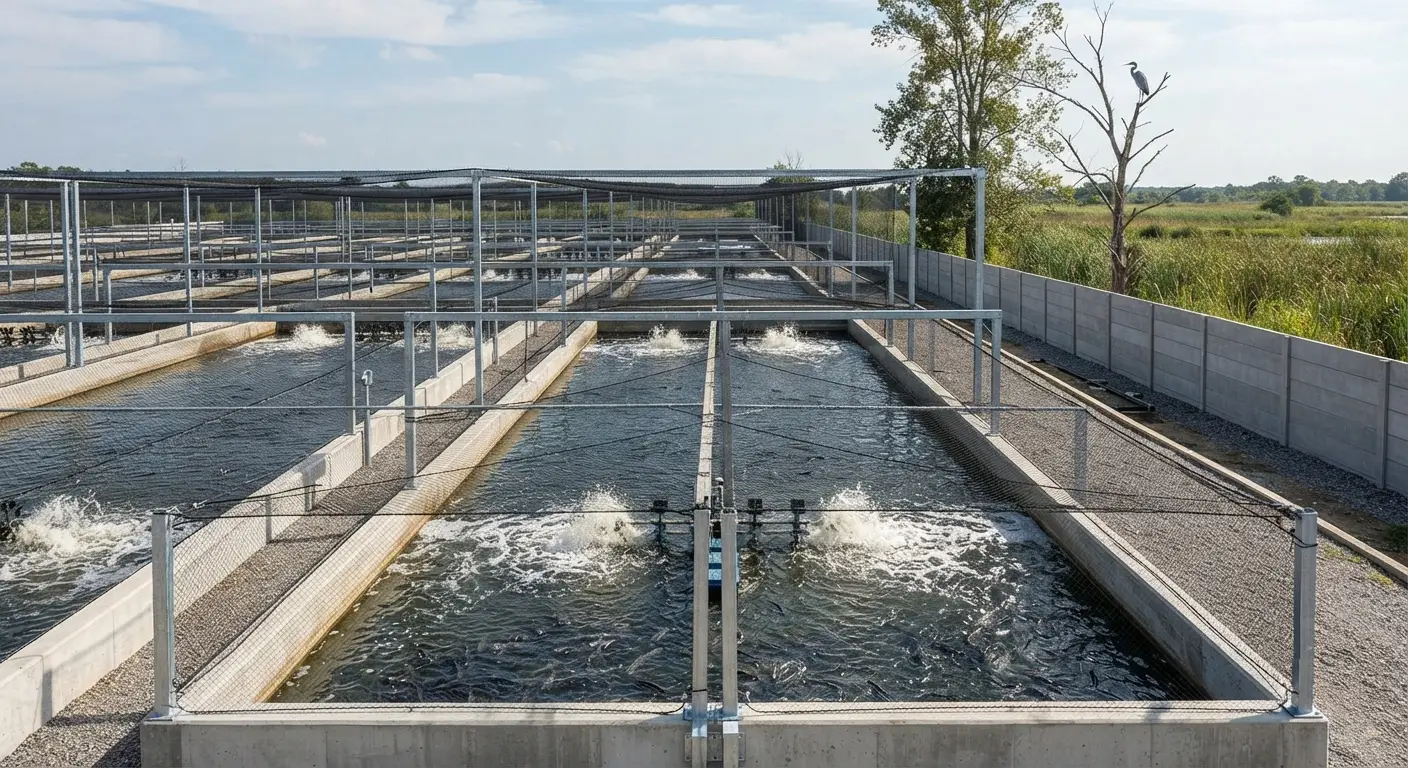
The most effective and most practical avian predator exclusion for concrete tank farms — a net structure covering the tank or the entire tank array prevents birds from landing on the tank edge or water surface:
Monofilament nets (0.8–1.2 mm diameter nylon or polyethylene filament, 3–5 cm mesh) strung between posts at heights sufficient to prevent birds from reaching the water surface below. The net should be taut enough that birds cannot push through it and large enough to completely cover the production water surface without gaps at the edges.
Shade netting: Shade cloth (50% shade density) over concrete tanks serves the dual purpose of reducing solar heat load (improving water temperature management as described in the water quality articles) and excluding birds — a single infrastructure investment that delivers two production benefits.
Pond exclusion challenges:
Covering large earthen ponds with exclusion netting is not economically practical for most commercial operations — the poles and netting required for a 0.5-hectare pond represent a substantial capital investment. Practical pond avian predator management relies on a combination of deterrents:
Scare devices: Reflective tape strung between poles at the pond edge, reflective discs suspended above the water, and motion-activated sound devices disturb birds that approach. Effectiveness decreases over time as birds habituate to non-threatening deterrents — rotate between different scare methods.
Visual deterrents: Artificial owl or hawk silhouettes positioned at the pond edge exploit birds’ natural avoidance of raptors. Again, effectiveness decreases as birds habituate — move decoys regularly.
Human presence: Regular patrolling around pond edges during the dawn and dusk periods when bird activity is highest disrupts feeding patterns. Not continuously effective but reduces the establishment of feeding routines.
Guardian species: Geese or guinea fowl housed near pond areas alarm-call when large birds approach — providing a warning system that stimulates catfish to dive deeper (out of surface-feeding bird reach) and alerts farm staff.
Reptile Predators
Monitor lizards (Varanus species): Found throughout West and Central Africa, monitor lizards are opportunistic predators of fish — they wade into shallow water and catch fish at the edge of earthen ponds. A large monitor (2–3 meters body length) can consume several kilograms of fish in a single visit.
Management: Physical barriers (perimeter fencing with apron at the base, as described in the site selection and biosecurity articles) exclude monitor lizards from enclosed concrete tank operations. For earthen ponds with perimeter fencing, the fence base should extend 30 cm below ground level to prevent burrowing entry.
Crocodilians: In areas where Crocodylus niloticus (Nile crocodile) or Osteolaemus tetraspis (dwarf crocodile) ranges overlap with farm areas, they represent a serious predation risk in earthen ponds — capable of consuming multiple large fish in a single night visit. Perimeter fencing with crocodile-proof concrete block or heavy gauge chain-link at the water edge is required in crocodilian range areas.
Aquatic Predators
Wild fish entering pond systems:
During flood events when pond bund overtopping occurs, or through poorly screened inlet structures, wild predatory fish can enter earthen ponds — consuming fingerlings and small juveniles and introducing the parasites and bacterial pathogens of their natural environment.
Predatory species of concern: Nile perch (Lates niloticus) where present, mudfish (Clarias wild populations), snakeheads (Channa species), and various other predatory species depending on the watershed. Even non-predatory wild fish introduce parasites — wild populations carry external protozoa (Trichodina, Ich) and monogeneans at levels that overwhelm commercial production fish whose immune systems may not be calibrated to the specific wild pathogen strains.
Prevention: Screens on all inlet structures (mesh of 3–5 mm — small enough to exclude most wild fish but large enough to maintain water flow) prevent wild fish entry through the supply system. Emergency overflow spillways should also be screened. After any flood event that overtops pond bunds, seine net the pond for wild fish before restocking.
Control of wild fish in existing ponds:
Before the first stocking of a new earthen pond, or before restocking a pond that has been contaminated by wild fish during a flood event, complete eradication of resident wild fish is required:
Rotenone treatment: A piscicide (fish-killing compound) derived from Derris plants and available as a commercial fishery management chemical — applied at 0.5–1.0 mg/L active ingredient to the pond water, kills all fish within hours. Rotenone degrades rapidly (3–7 days under tropical sunlight conditions) and is not persistent in the environment. After rotenone treatment and the degradation period, the pond can be safely stocked with catfish fingerlings.
Invertebrate Predators
Water insects (diving beetles, backswimmers, giant water bugs): Several large aquatic insect species are capable of killing catfish larvae and small fingerlings — diving beetles (Dytiscidae) and giant water bugs (Belostoma, Lethocerus species) are documented predators of larval and juvenile fish.
These invertebrates are most significant in hatchery and larval rearing tanks where their relative size gives them predatory capability over the microscopic early larvae. Management includes screening all water inlets to prevent entry (50–100 μm screening in larval tanks excludes most aquatic invertebrates), and manually removing any large insects observed in larval or fingerling tanks.
Integrated Biosecurity Management — The Annual Calendar
Building Biosecurity Into the Production Calendar
Biosecurity is most effective when its practices are routinized into predictable scheduled activities rather than implemented reactively in response to problems. The following annual calendar integrates biosecurity practices with the production cycle:
Before each stocking:
- Complete AIAO cleaning and disinfection of the production tank or pond (full protocol: drain, dry, lime, refill)
- Verify all inlet screens are intact and correctly sized
- Inspect perimeter fencing for gaps, damage, or burrowing entry points
- Verify quarantine facility is clean, functional, and ready to receive incoming fish
At each fingerling receipt:
- Activate quarantine protocol (Day 1–21 as described above)
- Collect samples for microscopy within 48 hours of arrival
- Administer prophylactic treatments according to microscopy findings
Monthly during production:
- Routine wet mount microscopy from all production tanks
- Perimeter inspection for wildlife access
- Avian deterrent rotation (move decoys, replace reflective tape)
- Disinfectant solutions verification (check concentration of stock solutions, replace degraded solutions)
At each harvest:
- Complete the AIAO cleaning cycle before restocking
- Inspect all equipment for wear or damage that creates pathogen-harboring surfaces (cracked plastic, corroded metal, torn nets)
- Review the disease records from the completed production cycle to identify recurring problems that require biosecurity adjustment
Annually:
- Review and update staff biosecurity training (new staff; refresh for existing staff)
- Review equipment inventory and replace worn or damaged items that cannot be effectively disinfected
- Review the quarantine record for the year — what pathogens were detected in incoming fish? Does this indicate a supply problem with a specific hatchery that warrants changing the source?
Summary
Biosecurity, quarantine, and predator control are the preventive layer that determines how much disease management work the catfish operation must do — farms with strong prevention systems do less disease treatment and spend less on antibiotics, treatment chemicals, and mortality losses than farms with weak prevention systems that are continuously managing diseases that entered through preventable pathways.
The pathway analysis in Part 1 — mapping the six specific routes through which pathogens enter commercial catfish farms — converts “good biosecurity” from a vague aspiration into a specific checklist of entry points to close. New fish introduction is the highest-risk pathway and quarantine is its closure measure. Water source contamination is addressed by screening and UV sterilization. Equipment transmission is addressed by between-tank disinfection discipline. Personnel transmission is addressed by hand washing and dedicated footwear. Wildlife is addressed by physical exclusion and deterrence. Feed and organic inputs are addressed by storage management and feed source quality.
Each closure requires investment — in infrastructure, in time, in management discipline. The return on that investment is measured in the disease events that do not occur, the antibiotics that are not purchased, the mortality that does not happen. That return is invisible when the biosecurity program is working — which is precisely what a successful prevention program looks like.